12 July 2017

IQ and the Hounds of Bakersfield

Sherlock Holmes updates are a plenty in the early 21st century. Guy Ritchie’s take has RDJ as a bare-fisted fighter. Steven Moffat’s Sherlock, like any Millennial, is glued to his Smartphone while Watson is married to a superspy. Then comes author Joe Ide whose eponymous character is a young, black man in LA solving crimes for the poor folk of the ‘hood for payments of blueberry muffins. IQ drives a maxed out Audi while Watson, this time going with the rhyming handle Dodson, is a Tupac-loving, ex-drug dealer. And brother it works.

Hardly your typical noir LA PI, Isaiah Quintabe is a quiet man who has the gift of observation. As a means of absolution, he simply wishes to help, while his former roommate, Dodson, who sets himself up as IQ’s business manager, gets him involved in a case involving a rapper targeted by a hitman who specializes in breeding pit bulls. Ide provides a hip-hop soundtrack as the unlikely duo works the case while the b-plot reveals the friends’ former criminal ways that breaks IQ away from the genre and into an untapped realm.

Ide’s dialogue is fresh and, typical of the Sherlock genre, revealing as IQ proves himself, distances himself, from mundane, particularly those in his community who see happiness by way of Benjamins and bling. The plot is fast and fun if even the solution runs on the convenient side. Best yet, Ide has a follow-up planned. Having more IQ is always a good thing.


As always,
theJOE

27 June 2017

Magic.

Magic. Pure magic.

A few themes were gleaned within the pages of Spoonbenders. Magic tricks come with a cost. True magic is often times pure luck. Case in point. Daryl Gregory shows that plot can outweigh craft as there is no special legerdemain present with his phrasing, his descriptions. But the story? The characters? Magic.

Spoonbenders follows the Amazing Telemachus Family, a one-time TV sensation of psychics and con artists who are now all older, sadder, and defeated. Irene, the eldest, is a single mother in a dead-end job. Frankie, who is always looking for the Next Big Thing, owes money everywhere, including the mob. Buddy is a clairvoyant basket case. Mattie, a teen barely coming into his own. And Teddy, the patriarch, who might be pulling one last confidence game in hopes to save everyone.

Gregory wisely turns away from setting up yet another X-Men style situation of freaks banding together outside of society in order to save it. Instead, he focuses on the normalcy, the relevancy, of the family dynamic and all its wonders: puberty, unemployment, sickness, marriage, failed dreams. He asks how can fame, something that was once briefly tasted, be regained? He sets up a ticking clock and a countdown to one glorious dénouement of card sharking, astral projection and, perhaps, with some luck, a little spoonbending as the reader is treated to a story full of amazement and wonder. And why not? Magic.

Many thanks to NetGalley and Knoff for this entertaining, magical read.


As Always,
theJOE

26 June 2017

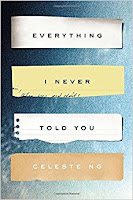
Compelling Mystery; Cliché Drama

Initially reading through Everything I Never Told You, those other players in the American family drama genre game come to mind. And not those pseudo-comedic slices of live stories that Parenthood and Grand Canyon were so fantastic at portraying, rather, something much more Americana – the family tragedy. Like Ordinary People, or American Beauty to be slightly more contemporary, where the family bond is decapitated by one destroying event.

The event within Celeste Ng’s book is the death of teenager Lydia Lee. Ng unfolds the mystery surrounding such – was her death a murder, a suicide, or simply a terrible accident – while revealing  the secrets, both personal and, more often than not, trite, of the entire Lee family. The Lees, a typical Chinese-American family living in Ohio in the late 1970s you see, are not so typical, as Ng presses to expand upon. And she mostly succeeds.

Those initial genre reactions degrade as the Lees, it is realized, are typical. They run through the same fears and desires and stresses of every other family, albeit without ready access to SSRIs. That normality that has been promoted to the super-normal becomes super-annoying as the novel digresses into a downward spiral of complaining, whining, and ungratefulness. James, the patriarch and provider, is stuck in a standard job. Marilyn, the Anglo-wife, who dreams of being more than a mom. The siblings, all three of them, are normal, and boring, and ignored, and invisible. Everything I Never Told You, builds on the compelling mystery of Lydia’s death on top of all the clichés of a standard drama yet is providential enough not to collapse.

Perhaps the most surprising theme uncovered is that Ng almost wants this mixed-marriage to fail. As if this novel were a thesis on how inter-racial marriages cannot, and maybe should not, succeed – a theme that when using a 21st Century vantage is most absurd. To her credit, however, she does emphasis the difficulties such a family dynamic would present, especially in 1970s Ohio.

Ng has a pleasant, accepting writing style and plots the story with a progressive pace aptly exploring each personality. Unfortunately, the deeper those characters become, the more vexing they are revealed to be and the easier to ultimately forget. The emphasis of a family tragedy is to grieve when these characters befall a certain fate. Otherwise, all you get is Hamlet. Everything I Never Told You is more akin to a sigh of relief.


As Always,
theJOE

08 June 2017

May Da Force Be With You!

Aside from being a Don Winslow fan and looking forward to reading his latest, having a cover blurb from Stephen King, the grandmaster of all, likening the book to The Godfather, well, that was one helluva an endorsement. And folks, Uncle Stevie’s assessment ain’t wrong.

Winslow’s The Force, set in a present day, post 9/11 NYC, is an in-your-face lesson of the realities of life and politics in the Big Apple so vivid you can smell the garbage. And if anything, The Force has a lot of it, including, at times, the book’s protagonists. Winslow, by way of Manhattan North Special Task Force lead Det. Sgt. Denny Malone, plays host and opens a tour of Harlem - the eateries, the theaters, and also the projects, crack houses, safe houses, hospitals, and precincts - all through a clipped, narrative slang that would make Raymond Chandler proud were he alive and reading in the 21st Century.

The Force, consisting of NYPD blue bloods Malone, Russo, and Montague, play kings of their kingdom. Tolerated by those they seek to protect, hated by the skells they are up against. They rule by fear, by strength, and sometimes are even in alignment with the law. They seek power by taking power, as well as few token items as spoils of war, being victors and all that. Yet they are brothers. Family men. Lovers, and jesters. They want to do right for their kids and succeed enough to shower off the filth of the day. But things go wrong and kings often become conquered. Think The Shield but East Coast style.

Winslow does more than simply present another tale of cops gone bad. He tells how. He tells why. And he even attempts to provide justification, albeit through the Hollywood convenience of showing others as more reprehensible than those of the hero cops. The Force does question the blatant lack of values, demanding a return to uphold a higher honor in truth and justice. A theme that Winslow sidesteps, proclaiming instead that the end justifies the means. Except it often doesn’t. In life anyway. In Winslow’s New York? Being a bad ass with a shield of gold and fists of tempered steel? Might just be the coolest cat this side of Vic Mackey.


As Always,
theJOE

27 May 2017

Genre Fare, Neither Dark nor Forbidden

A gothic horror romance starring Deadman? Think about it. A match made in Nanda Parbat, right? Shockingly, no. Deadman: Dark Mansion of Forbidden Love mostly focuses around Berenice, a woman who is sensitive to, and can observe, ghosts, with Deadman underwhelmingly being used as a plot contrivance. Writer Sarah Vaughn provides a standard offering to the genre: murder, lost love,
unrecounted love (inexplicably gay love at that; a plot element tacked on seemingly to satisfy a quota and never explored or explained), and the unsurprising return of a dastardly villain steeped in the dark arts.

As for the art? Lan Medina showcases slick, detailed visuals that, when paired with digital painter Jose Villarrubia, transcends the typical graphic novel medium, look more akin to storybook art than superhero. Berenice is rendered as a normal, standard woman that definitely, and refreshingly, stands in contrast to the super-human existence of Boston Brand.

The art also contrasts against the staggering commonness of the story itself. Vaughn and Medina work together to produce a few genuinely creepy moments, but those are quickly forgotten and generally dulled down by a slow-moving plot complete with meaningless internal dialogue that would certainly have Frank Miller screaming at the walls of his studio in frustration. If anything, Dark Mansion of Forbidden Love shows that nothing is scarier than longing looks at an antique store.
Right.

Thanks to DC Comics and NetGalley for the ghost of a chance to read the advanced collector’s edition. This is a genre ripe for the taking in the magical DCU; it just needs to be properly grabbed.

As Always,
theJOE

26 May 2017

A Procedural of Firearms from the 1930s

Somewhere within this concrete block of a novel, under the preposterously-macho dialogue, away from the run-on sentences filled with description upon description upon description, not to mention chapters worth of the intricacies involved with breaking down firearms, there lays a cool, fast story of historical fiction playing out a hard-as-balls Agent and his hunt of a wilily, rascal of a bank-robber. To find that story, brother, break out the chisels and jackhammers, as it’s a deep dig.

G-Man places the fictional character of Charles Swagger right into the state of play between the burgeoning FBI and a series of public enemies on the prowl in the early 1930s, such as the likes of John Dillinger and Baby-Face Nelson. Author Stephen Hunter adds to this narrative a present-day tale of Swagger’s grandson, Bob, and his quest to uncover the mystery of his grandfather. Both tales, alone and inter-twined, make for great pulp, crime fiction. Hunter unfortunately burdens that plot, something that should be hip, and light, and full of that post-1920s swing, with the procedurals of an old man telling a young whippersnapper the right way a task should be done.

Maybe this is simply Hunter’s style
that I, as the reader and reviewer, have not previously been privy to. However, as a reader and reviewer, I found his unyielding verbiage to be unnecessarily weighty, making for a dull read. And a release from an author named Hunter, featuring a character named Swagger, and with the cover boasting a fedora-clad agent bearing down with a Tommy gun, should be anything but dull.

A hail of bullets in thanks to NetGalley for the ARC.

As Always,
theJOE

23 May 2017

A Short Story Slowly Expanded Upon

In a strange set of circumstances, Neil Gaiman’s Neverwhere is a novelized adaptation of a BBC miniseries he co-created. Working backwards, as opposed to having a written work adapted for film (Stardust) or TV (American Gods), Neil fleshes out the everyman hero of Richard Mayhew and delves deeper into the fantastical and eye-winkingly comical land of London Below, complete with black friars and elephants within castles, and where Richard, looking for an exit back to his terribly-mundane and beautifully-predictable life, is essentially trapped after helping the injured Lady Door. The question being if such elaboration was entirely required.

Certainly, Neverwhere is completely Neil Gaiman. The worlds are imaginary, the characters are rich of back-story and tales, and his intricate writing style flourishes with grand, beautiful descriptions of settings, feelings, and thoughts. Through all that, Neverwhere is also too long, too slow, many of its scenes are missing the pop of a fast-paced television series.

Neverwhere could have been a fantastic, longer entry in Trigger Warning, Gaiman’s 2015 collection of short-ish stories, or even a novella akin to Ocean At The End Of The Lane. The complete novelization of Neverwhere makes a tiring marathon out of what could have a pleasant afternoon jog. Absolutely, an enjoyable, magical read by a master, but shorter can sometimes be sweeter.


As Always,
theJOE

10 May 2017

The Exodus to the Promised Land Requires a lot of Hot Air

Robert Hobkirk writes dialogue. A lot of it. That is his craft. He truly gets into a story and how a character tells that story through well-written and believable, albeit sometimes terminally-long, dialogue. Yet in the midst of this talking and storytelling and crafting a character’s thoughts rather than action, the narrative is forcibly reduced. The characters become compelling, and not necessarily likable, which is a perfect echo of the relations of everyday human life, their stories believable, but their situation, their surroundings, falter as that external impetus does not become a driving force. Tommy’s Exodus, then, comes to close to basically being a collection of well-told experiences within an anthology-style framing sequence.

With Tommy’s Exodus, Hobkirk presents the titular character as a veteran back from Afghanistan and on a loser’s path in LA – nearly homeless, alcoholic, and penniless – who decides to hightail it back to the familial home in Sacramento. Hence the exodus. And in a Joseph Campbell by way of Homer fashion, our hero encounters a number of challenges that he must overcome, or, in typical 21st century slacker American standards, ignore until they go away. Chief among these challenges is the antagonist Pharaoh, after all, you can’t have an exodus without a Pharaoh to run from. Tommy’s next totally-relatable nemesis is even worse: the US healthcare system.

Through it all are Tommy’s many interactions; talk, the constant telling of stories be they relevant to the plot or not. And those that are not, which are plenty, as Hobkirk gladly, although kindly, plays out his ruminations and philosophy, including a prolonged spot of right-wing talk radio, lengthen that end game. Tommy’s Exodus often times reads like a script to a compelling play as the narrative is the character. Scripts, however, don’t always make for the most complete of reading experiences. 

Hobkirk beautifully builds within Tommy a unique, moral character who makes mistakes – plenty of them – and is also keen on changing his mind. Similar to a talkative co-worker or the guy behind the counter at Five Guys, Tommy is also annoying but wants to be heard. Hobkirk succeeds in giving Tommy that voice while demonstrating that the journey of the exodus might be more compelling than the reaching of the promised land.

As Always,
theJOE

08 May 2017

Inconsequential Change

DC Comics’ Rebirth event, other than a marketing tag, really should be about the exploration of themes. A look at what makes the character appealing and an examination of those personal, internal forces while dealing with the colorfully-ludicrous external. Unfortunately, with the Rebirth collections DC Comics and NetGalley have graciously sent my way, there has not been a sense of regrouping, of growth, or internalization. The stories are an onslaught of constant motion opening with panel one and nary a chance for an asterisked footnote to a Wikipedia article let alone time for introductions, and no more so than Blue Beetle Vol. 1: The More Things Change.

Blue Beetle tries, sincerely, and sometimes achieves partial success, to be clever with the pairing of Jaime Reyes, the Blue Beetle, and his mentor/Alfred Pennyworth surrogate Ted Kord, the former, and formerly deceased, Blue Beetle. Their relationship is ripe with all the elements of great buddy-cop entertainment, but man, that fruit just ain’t ready to pick. Blue Beetle Vol. 1, again like other Rebirth titles, are full of these sudden starts, fits of action, with explosions of rat-a-tat dialogue, that don’t go anywhere and have no signs of resolution, which is extremely detrimental to, what should be, a contained graphic novel and an invitation to go further.

Keith Giffen, who created the Jaime Reyes character following the massive Infinite Crisis storyline, which began with the surprising murder of Ted Kord, presents dialogue-heavy issues and truly does wish to make Jaime as likeable and as important as his blue alter ego. After all, one of main reasons Spider-Man is immensely popular is due to the relational aspect of Peter Parker, as opposed, for instance, to the Hulk, where the very-human Banner can indeed come off as, well, puny. Alas, Giffen never gives that reader, and presumably a first-time reader at that, the chance to truly enjoy the character because the opportunity is never provided. The shark-like, always-moving-forward motion does not allow that pause for reflection.

Giffen and co-plotter/artist Scott Kolins present the Blue Beetle scarab as a threat to Jaime’s well-being, a plot element that will no doubt continue to grow as the series continues. Giffen allows Doctor Fate a co-starring gig in the title, and I, for one, always enjoy Giffen’s Fate. Kolins gives the character an updated makeover, but even the character’s inclusion is sparse and seemingly inconsequential as the mystery for his inclusion, and what should be a build up to this threat, is nearly trivialized away in an is-it-or-is-it-not dream sequence.

Comic books have a grand tradition of excelling at the slow burn. How many decades did Superman and Lois Lane flirt? Even Ted Kord’s own Blue Beetle title from the post-Crisis eighties had an over twelve-issue long b-plot that simmered, at varying levels, every issue. The problem with Blue Beetle Vol. 1: The More Things Change is there are too many simmering pots and not enough pasta. The old adage about waiting for that water to boil could very well result in no one bothering to pay attention when supper is ready.


As Always,
theJOE

25 April 2017

Heroes of the Frontier

Magnificent.

Dave Eggers presents a grand, heroic look at the threatening frontier of Alaska that is ironically both frozen and constantly fraught with forest fires. Simultaneously, he presents within Josie, a single-mother perpetually on edge of either a nervous breakdown or looking to succumb to rampant alcoholism, the heroic, and all-too human, qualities of running away while running towards. All throughout Heroes Of The Frontier, Josie, along with her two young children, Paul and Ana, completely, and even triumphantly, does both.

Eggers manifests within the novel a philosophy of life, marriage, the tediousness of parenting, and, most importantly, the need to grab hold of that golden ring. Through Josie, we get quirky, and often times hysterical, looks at the insanity of a grade school event schedule, the requisite stupidity of musicals, the glaring monotony of dentistry - perhaps the daily professional grind we all must endure - and the absolute joy of singing, dancing, and communing with live music. Josie embarks on her hero’s quest, destination unknown, hoping to find herself while going off the grid, discovering unabashed kindness and typical American anger. She loves her children, but maybe isn’t the best of parents. She wishes to remove herself from society, but seeks out companionship. She drinks, too much and too easily, but she also laughs, and smiles, and, eventually, does her best to forgive.

Like all great stories, the finale comes sooner than expected. However, the ultimate ending escapes complete fulfillment as earlier steps in the journey might have been more resolute in the closing of the circle. Then again, maybe I did not want this tale to finish. I wanted the fierce mystery of Alaska to unwrap and unveil as Josie continues her eternal quest for resolution and her well-deserved happy ending, as do we all; all of us heroes in this unending frontier.

As Always,
theJOE

10 April 2017

Hellblazer-lite

As a long, longtime fan of John Constantine, the Hellblazer, whose last contact I had with the character, outside of Arrow, was Hellblazer #300, I was both anxious and guarded when the advance preview of his Vertigo-less Rebirth series from DC Comics and NetGalley arrived. Overall, this first collection of Rebirth issues is fairly entertaining, albeit straightforward, gluten-free with no additives, essentially, Hellblazer-lite.

For this first volume of The Hellblazer, entitled “The Poison Truth”, writer Simon Oliver, who once visited John in the surface-level-enjoyable Chas: The Knowledge, brings John back to London (Living NYC, presumably, due to the New 52? Ah, DC) where he immediately gets mixed up in conning his way out of a demon’s curse that, similar to the story in Chas, ends abruptly and simply. Again, Hellblazer-lite.

Oliver’s script then splits off into two paths. John and a telepathic girl named Mercury go looking for an ancient Djinn that has been lurking in the shadows of history laid out in a tale that seems to have been gleaned from Helene Wecker’s fun novel, The Golem and the Jinni, while the always-welcome guest-star Swamp Thing, who is actually presented more like a co-star bringing about a fun if accidental update to The Brave And The Bold, goes on a quest for his wife, Abbey, who is now also an elemental (see again: New 52? Then again, perhaps not). Unfortunately, this first collection comes to it culmination just as both streams head deeper into their trajectories. Let’s hear it for the modern-day cliffhanger. Although, having John and Mercury arrive in Paris doesn’t quite have the same punch as, say, Rey presenting Luke with his lightsaber, but admittedly, I am curious to see what happens next.

The artwork is also split in twain between Moritat, who provides a cartoony, almost European design, and Pia Guerra, formerly of Y The Last Man, whose crisp, clean work is always a delight to see.  John Cassady provides covers that, although not as strong as Hellblazer classic artists Glenn Fabry and Tim Bradstreet, are right in line for this Hellblazer-lite.

Six issues and Oliver’s work is fun but a better pacing needs to be developed for upcoming issues as too much time is spent within on characters not named John Constantine. A lot world building, or revisiting, going on that, hopefully, will lead to a big payoff that might even have the potential of Paul Jenkins’ finale run.

Hey, at least John hasn’t been neutered from his Silk Cut habit.


As Always,
theJOE

04 April 2017

A Halloween Scare… for the Movie of the Week

The Halloween Children moves with the grace of a zombie crawl. Like a found-footage horror movie from the 70s the book is a slow, tiresome read of nothing more than enlightened transcripts where the big boo doesn’t shock ya until deep in the third act. And that shock? Well, nothing long-time genre aficionados would need to check on their blood pressure meds over.

Co-authors Brian James Freeman and Norman Prentiss set the stage in a prime place for a haunting: a high-turnover apartment complex. Yet aside from a few groans and whispers and things going bump in the night, the primary focus of the tale is on the fantastically bad relationship of hellbound-parents-of-the-year Harris and Lynn. The couple so incredibly dysfunctional they are presented as cliché caricatures, whose lives are boring, miserable, and uneventful – until the event that occurs within the apartment complex that is supposed to bring the family together and rise up against the demonic invaders in great Spielberg-ian fashion. Except that never happens. Perhaps to groove to a modern audience, the authors present the third-hand details of the account by way of interviews and (prepare for a shock) emails.

Terrifying. Even more disturbing? No Twitter feed.

Interestingly, there is almost no development with the titular characters – the children themselves.

Freeman and Prentiss truly attempt to make a creepy Halloween tale. The slow pace and an unsatisfying build up make this one all tricks and no treat.

Fun-sized chocolate bars a go-go to both NetGalley and Hydra for the ghoulish opportunity of the advance copy.

As Always,
theJOE

24 March 2017

Liner Notes

Unstrung Heroes is author/musician Pete Braidis’ love letter to guitar players and guitar playing. In doing so, he interviews 50 guitar greats whose work is familiar regardless if their names are not. Case in point: Vic Flick. Who? Well, that’s his iconic riff in the James Bond Theme first heard in Dr. No. Braidis possesses enough knowledge of these players and their works to, well, fill a book.

Calling Unstrung Heroes a dense read is akin to calling Andy LaRocque (King Diamond’s guitarist, and interviewed within) metal. Braidis, however, wants to give these players a well-deserved spotlight and does so by saying hell to any editing, which is truly this book’s only downfall. Featured within are such greats as Davey Johnstone, David Rhodes, Eric Bazilian, and Martin Barre, from Elton John, Peter Gabriel, the Hooters, and Jethro Tull respectively. Certain interviews were the result of email exchanges and play out with all the enthusiasm of a message board. Those in which a true conversation occurs makes for a more lively read allowing Braidis to mix in natural humor as he professionally plucks at those strings of those being interviewed in order to achieve a desired tune.

Paul Hammond, of the Zeppelin-tribute band Get The Led Out, and Steve Rothery, of the Scottish Prog vets Marillion, stand out as highlights of such conversation providing breadth, scope, and passion in their craft. Ironically, one of the book’s most recognizable names, Steve Hackett, of Genesis fame, comes across subdued. Fortunately, there are plenty of others’ who have an abundance of energy; looking at you, George Thorogood.

Unstrung Heroes makes for a great coffee table book and one that is accessible enough to pick up and jump through several interviews at a time.  Mind, this is also a book about musicians for musicians, where guitar types, chord progressions, and timing signatures are all discussed, occasionally in great lengths. But there are also just as many cat jokes for the lay person to, well, lay their claws into when they want to shred.

As Always,
theJOE

19 March 2017

A Graphically Novel Approach to a World of Decay

Yet another entry to the ravaged world of the zombie apocalypse, Zombies: A Brief History Of Decay is a dense read that fully embraces its entrance as both graphic and novel.

Writer Olivier Peru and artist Sophian Cholet present their entertaining take on that post-apocalyptical struggle that is now oh-so familiar. In this world, zombies can be both slow and fast, based on the rate of their decay, but even more surprising is the fact that humanity abandons the every-man-for-himself thieving personae most commonly seen and wants to work together to rid themselves of the plague. Well, except for a band of white trash wanna-be survivalists held up in, naturally, a Wal-Mart. 

Peru has the remains of civilization residing in floating armadas on both the Mississippi and the coast off Seattle, and scripts the main characters as a worthy nation looking to survive and rebuild, with a few personal quests added for spice.  Unfortunately, and perhaps this is a by-product of the collected edition, there is limited consistency between the several separate plots. Breaks don’t come naturally forcing the reader to back-up and regroup. In this regard, Cholet’s incredible layouts and design lapse into a droning sense of sameness, particularly with the representation of the main male leads who are all white with dark hair and beards. Removing any familiarity with the characters reduces that emotional connection.

Zombies shamelessly captures the worlds of Romero and Kirkman and makes an entertaining quest out of the venture with plenty of subtle zingers that can be followed up on in a sequel.  Peru and Cholet show both the decay of humanity and civilization, but tease the reader with something everyone universally wants, hope and a future.

Many thanks to NetGalley and Insight Comics for this decaying advance read.

As Always,
theJOE

10 March 2017

A Paranoid Hawkeye

Veteran writer Christopher Priest returns to comics for the DC Comics Rebirth event in  Deathstroke, Volume 1: The Professional. Priest, ever the professional himself, utilizes all the standard tools that has made his arsenal familiar: quippy dialogue, chapter headings, sometimes-confusing flashbacks, and, oh yes, planting the seeds for a long play.  For the most part, his devious tactics are all on point, but with this collected edition falling under the Rebirth project, the mighty Priest may have failed in one main regard: this series was not all accessible for the new reader that DC was obviously attempting to recruit, especially, perhaps, after the character’s long-run on CW’s Arrow.

The Professional does not get into an origin, or at least, not linearly, which is as fine as it is stylish. Priest has the reader immediately jump into action as Slade Wilson, Deathstroke, politically, if not violently, acts with an African government in order to rescue a friend. And then Wilson’s family arrives. Using the term “dysfunctional” as a description for this family is akin to calling President Trump “loud”. The dynamics are fun as the mystery begins. Again, Priest is no doubt looking into the long play. Wilson kinda-sorta teams up with his illegitimate daughter, Rose, the would-be assassin called the Ravager, in order to find out who put a price on her head. The two go on a road trip to Gotham City as their dynamic plays out like a paranoid version of Clint Barton and Kate Bishop from Matt Fraction’s Hawkeye run.

For those coming in fresh, again, which one assumes is one of DC’s main sticking points, almost none of this would make sense. Rose’s genealogy, the lives-and-deaths of Grant and Joe, Slade and Adeline’s marriage, all falls back onto the heavy pre-52 continuity that old-time fanboys such as myself enjoy, but could be a huge question mark emoji for younger millennials.

Carlo Pagulayan, and especially Joe Bennett, provide thick, beautifully laid-out pencils, but at times the similarity between characters without the surname of Wilson, lends to some of the confusing narrative. Speaking of returning vets, much appreciation to seeing Larry Hama’s name grace the credit box for breakdowns on issue one.

Priest has laid the groundwork for what can be fun run, especially now that the obligatory Batman guest spot is out of the way. Maybe this will also give Priest the chance to clarify his narrative and make Deathstroke more Leon and less Walter Sobchak.

Thanks to both NetGalley and DC Comics for the advance preview of the new Deathstroke title. Reminds me of my letterhacking days and receiving similar advance copies for solicitation. I’m glad to be able to contribute such reviews again.


As Always,
theJOE

06 March 2017

Suicide Squad: Heavy on Explosions, Light on Intrigue

A new, albeit familiar, Suicide Squad is formed as part of DC’s Rebirth project and easily falls in line to capitalize on the familiarity that the recent film provided. And like the movie before it, the comic is generic, played safe, and features a linear, if head-scratching, plot.

The premise is tried-and-true and even a bit cliché at this point. The baddest of the bad are recruited by the government to be the ultimate of shadow ops and installed with missions that no one in their right mind would take on. All of the usual personalities are in place for the role call: the assassin Deadshot, the Joker’s protégé Harley Quinn, the merc-with-a-gimmick Captain Boomerang, the cannibalistic-mutant Killer Croc, and so on. The basis for the organization is an easy one, and the formula is ripe with success. However, the plot for this graphic novel, much like the feature-length film, is as lackluster as it is frustrating. 

For this particular starting point, the team is hastily put together in order to invade a secret Russian vault and abscond with a Phantom Zone generator. Yeah, like that Phantom Zone. Superman and General Zod and all that. Instead of a mirror floating endlessly in space, this portal is represented as a back orb. Yet never in this story, and perhaps this why the “Volume 1” designation appears, does writer Rob Williams bestow any answers for the whys. Why does Russia have this? Why does America want it? And why send a squad that is almost entirely comprised of typical human agents who simply wield guns, swords, or, well, boomerangs, to go against a potential Kryptonian menace? Hello, yellow sun. And finally, with all that has happened before with this series, even looking back to the John Ostrander and Luke McDonnell’s conception back in the eighties, why isn’t this introduction more exciting? Jim Lee’s artwork, which is merely serviceable in this outing, does not provide any further answers.

Fortunately, Suicide Squad, Volume 1: The Black Vault contains some entertaining back stories on key characters. One to note of features the gorgeously illustrative work of Gary Frank spotlighting Harley Quinn. Another focuses on Captain Boomerang and his amusing fantasy of being an Australian super-spy. Both of these tales were written by Williams, proving he can break out the imagination when needed and crafts the back-ups with more attention and appeal than that of the main plot. Maybe that imaginative force is behind bars at Belle Reve and is only allowed to work on certain missions? Yet another question that requires an answer.

Thanks to both Netgalley and DC Comics for the advance preview of the new Suicide Squad title. Reminds me of my letterhacking days and receiving similar advance copies for solicitation. I’m glad to be able to contribute such reviews again.

As Always,
theJOE

04 March 2017

Ready, player one? Perhaps not...

Ready, player one? Then get ready for Armada, the latest in sci-fi shoot ‘em ups where, and get ready for your mind to be blown, you are not playing a video game, but instead are helping the Earth Defense Alliance in repelling an alien invasion. Waitaminute, you might say, that sounds exactly like The Last Starfighter, or Ender’s Game. Unfortunately, you are correct. Nothing else to see here. Game over, man.

Ernest Cline’s follow-up novel sadly does not live up to the hype and excitement that was abundant in Ready Player One.  The characters within are as cliché as they are one-dimensional with bulky-dialogue soaked in Gen-X nostalgia that goes way outside the realm of being believable. If it wasn’t for the R-rated language, one might think Cline could have presented this as a stellar YA novel and built a unique story on top of what has come before. Instead, he takes a shortcut and interlaces the tried and true with inundated references to the Stars, Trek and Wars, among many others.

Ready Player One was fun and new with characters that were developed and continued to develop. Armada was a fountain of clichés; an arcade experience that becomes mostly forgotten once your quarter disappears into that slot.


As Always,
theJOE

28 February 2017

Trying to recapture a little of the glory of

Bruce captures his glory days – and ignites them – in his autobiography Born To Run. Ever the craftsman, the lyricist, the poet, the storyteller, the everyman, Bruce Springsteen pens in his memoirs in an enlightening, entertaining way that anyone from the hardcore fan who knows every song by heart to the casual listener who thinks “Born In The U.S.A” is a patriotic foot-tapper will find enjoyable and, believe it or not, relatable.

I waited until this book was available on Audible for the sole purpose of getting the chance to listen to Bruce, to the Boss, to have him tell his story directly to me. His book is not only full of tales from his life, but his philosophy on rock music; his responsibilities to his fans, his band, and his family; how weakness can make one stronger; and how to be an inspiration. 

For over 18 hours, I got to listen to one of my heroes talk to me. I heard intimate stories, rowdy bar tales, rock’n roll hobnobbing, and the fears that most every father has. Bruce talked - to me - about all these and more for over eighteen hours. And I cannot wait to listen to it all again.


As Always
theJOE

24 February 2017

Academy Awards - 2017


No rant this year; just a quick rundown of my guesses on how Sunday’s Academy Awards show will go. And with La La Land set to win it all – or most anyway – why bother with analysis. Right?

But, this is my digital stage and would like to point out one observation. I don’t think the rolling number of Best Picture selections is working as it was intended to do, at least for this year. The idea behind the concept was to allow more mainstream, if not, gasp and shock, critically-achieved blockbusters, into the mix allowing a more open and fun debate. This year, all nine films, with the exception of Hacksaw Ridge – and maybe Arrival – are essentially the same: art-house awards fodder or select genre niches (one western, one musical). This year lacks that Mad Max: Fury Road or Martian or American Sniper. That one dark horse contender people smile about. Then again, maybe 2016 didn’t have the chance to present such a film. Except for seeing Captain America and Iron Man go all fisticuffs on each other and a CG Princess Leia, perhaps smiles were at a minimum this past year, meaning the movie-making business on a whole is failing at its one cultural responsibility.

My entries below are who I think will win, along with a very few comments. Before that, some quick analytics based on those choices. I have La La Land set to win 9 of its 14 noms. Fences gets two, both acting. Disney family films = 3. Films set in space (Star Trek Beyond) and Iran (The Salesman) will each get one. But, alas, no Oscar gold for The Lobster, regardless how original the story.

As Always,
theJOE


PICTURE / ACTING CATEGORIES
Best Picture: La La Land
Best Director: Damien Chazelle, La La Land
Best Actor: Denzel Washington, Fences
Best Actress: Emma Stone, La La Land
Best Supporting Actor: Jeff Bridges, Hell Or High Water (Mahershala Ali, from Luke Cage, I mean, Moonlight, is the favorite to win, and very well could, but Bridges is Hollywood royalty and with La La Land set to win, I think the Academy will maintain that “awarding Hollywood” sensability)
Best Supporting Actress: Viola Davis, Fences


SCRIPTING / MUSIC CATEGORIES
Best Adapted Screenplay: Moonlight (but really, Arrival should win)
Best Original Screenplay: Manchester By The Sea
Best Original Score: La La Land
Best Original Song: “City of Stars,” from La La Land


OTHER RACES
Best Cinematography: La La Land
Best Film Editing: La La Land
Best Animated Feature: Zootopia
Best Costume Design: Jackie
Best Documentary: O.J.: Made In America
Best Foreign Film: The Salesman
Best Makeup: Star Trek Beyond
Best Production Design: La La Land
Best Sound Editing: Arrival (although La La Land could win this one)
Best Sound Mixing: La La Land (although Hacksaw Ridge could win)
Best Visual Effects: Jungle Book
Best Documentary Short Subject: Joe’s Violin
Best Animated Short: Piper
Best Live Action Short: Sing

06 February 2017

Far Out Cosmic Fun –or– A Surfboard is way cooler than a Police Call Box

Fun.

Pure, undiluted, make-you-smile fun. How’s that for a review on Dan Slott and Mike Allred’s Silver Surfer: New Dawn graphic novel?

The Surfer has always been a personal favorite. Be it Stan “The Man” Lee and Big John Buscema’s angst-ridden late sixties run, or the Jim Starlin-Ron Marz-Ron Lim galaxy-crushing saga from the eighties/nineties. But many times, the Surfer’s stories can be heavy, both emotionally and thematically, with deep ties to back-story and cosmic ramifications involving the greater Marvel Universe. Not so here. Seen through the wide-and-accepting eyes of Dawn Greenwood, Slott’s clever scripting has the reader jump into the action with catch-up-as-you-go dialogue as Allred’s visuals hearken back to a Kirby-infused style yet retain his trademark pop-culture feel. The result is a lighthearted, fast-and-fun romp that ends much too soon.

Although Slott unabashedly steals the concept and motif for these stories from Doctor Who, the format works. The Silver Surfer, as a former herald of the world-devourer Galactus and now wielder of the power cosmic, makes for a great master with Dawn as a completely-likable and understanding companion. Yeah, his surfboard is not bigger on the inside, but it does respond to vocal commands. And Dawn? She actually makes the Surfer laugh. Which then makes me laugh.

So yeah, fun. Cosmic style.

As Always,
theJOE