30 March 2018

100 Silver Bullets

Let’s hear it for comic book vets taking a bite outta originality. New York gangsters with Tommy guns and spats go up against Appalachian hillbillies and their missing teeth for remarkably distilled hooch during Prohibition. And oh yeah, there’s a werewolf or three out there on the prowl going all Gary Brandner because, man, this is comics!

MoonshineBrian Azzarello excels – in short bursts – when working within the crime genre. His plots are quick, at times convenient, and his dialogue rat-a-tat fun as his work on Jonny Double and the first two-ish years of 100 Bullets can attest to. With Moonshine, his double entendre is as fun as his characters are cliché, completely fitting the bill for an Edward Robinson meets Lon Chaney, Jr mash-up. Eduardo Risso is never finer then when drawing a femme fatale or a Ford Model A, and he gets the chance to showcase both, along with a bunch of shadows, negative space, and man, that full moon, throughout this first volume.

Moonshine tells the tale of Lou Pirlo and how he gets caught in the world of, well, moonshine and, in a way, silver bullets. Written in a noir style, Lou quickly realizes he is in trouble and completely out of his New York state of mind. He’s drowning while gulping down every last drop of that nectar. Azzarello builds on the mystery while Risso paints trees of orange and rivers of red – along with the requisite shoot-em-ups.

Yeah. Good stuff. Tons of fun that will hopefully never become a show on HBO.


As Always,
theJOE

29 March 2018

It's war, I tell ya!

Author Omar El Akkad imagines in his first novel how the ravages of the Second American Civil War separate a late 21st Century America and divide its people. From a premise, and with that war as an intriguing backdrop, American War moves beyond the dystopian stories that are all the rage and presents a believable time, where climate change has altered the map, and made proud Southerners refugees in their own nation. El Akkad has a beautiful writing style and digs deep into presenting the future as history. Unfortunately the narrative doesn’t hold up as strong, becoming an exile within its own prophetic stance.

American War tells the tale of Sarat Chestnut, who becomes a revolutionary for her people, although the majority of her “people” never ask her to step up, don’t exactly understand the need of a hero, nor are they in the mood, aside from other self-entitled revolutionaries who seek to propagate the war for the sake of simply fighting, to enshrine one. Which brings forth the question: what is the investment for the reader? El Akkad is extremely obtuse in supplying an answer.

El Akkad, born in Egypt, and raised in Qatar, definitely possesses a unique view of Americans and the whole mom-and-apple-pie way of life. His time as a journalist helps extend his unique, and believable, setting, complete with all its ideologies and theologies but cementing in the proof that violence begets violence and brother, that’s all Sarat is. And that is her downfall as a character. She is not provided with the chance to be cherished. She becomes a tool of an obtuse agency and is set on her way going through a series of challenges and torture that has been seen before, and handled better.

The tale of Sarat is bookended by the narration of her nephew, who obviously loves his aunt and understands her cause. She is the one he worships when all others have turned away. He presents her life as one being worthy, one with reason. And that is the story this book should have been.


As Always,
theJOE

07 March 2018

Escapism

Brad Meltzer - Escape ArtistNew York Times best-selling author Brad Meltzer returns with his latest thriller that easily contains everything one would expect from the author, and from the genre. Like any disaster movie from the 70s, The Escape Artist is heavy-handed for the first full half of the book. Packed with character development (A divorced military mortician with a conveniently-short nickname! A hotshot, always-in-control artist with trust issues on the move! Dastardly-evil killers on the prowl!), situational set-ups (Flashbacks to the past that are haunting and relevant! Escape from Alaska! Dover Air Force Base, because, Delaware, man!), and of course, a hefty heaping of people sticking their noses into business they should leave well alone. But seriously, without these tropes, where would the fun be?

The Escape Artist is a fun, escapist (ahem) read, once the action finally kicks in during the second half of the book. Betrayals, twists, and revelations a plenty that are satisfying and, in a few instances, actually surprising. Having the lead, Jim “Zig” Zigarowski, as a military mortician is a unique archetype, as is Nola Brown, the Army’s artist-in-residence. Meltzer makes great use of the setting, bringing realism and an authentic look at the procedures for an Air Force base dealing with care for the fallen.

Whereas his angle of incorporating Harry Houdini and his devices in with the US Government is as close to the standard conspiracy-theory-Meltzer as this book gets, that is the one plot element that deserved more attention instead of focusing on the standard cat-and-mouse chases involving Zig and Nola and their nefarious assailants. After all, this is The Escape Artist, not The Mortician. A deeper sense of legerdemain would have been most appreciated. The true escape artist here is Brad Meltzer himself, who pulls back the curtain on a fun, albeit standard, genre thriller.

Thanks to NetGalley and Grand Central Publishing for the advance sleight-of-hand read.


As Always,
theJOE

28 February 2018

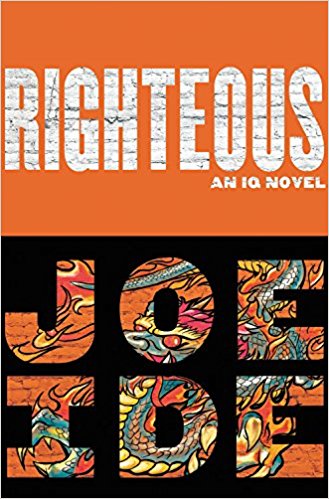
Righteous

Somewhere, either on the dust jacket or within on the literary reviews page, Florida-based writer Carl Hiaasen offered an outstanding critique of praise stating, essentially, no matter how fast Joe Ide writes, it’s clearly not fast enough. Couldn’t agree more. After reading Righteous, I need IQ #3 to drop on the market right now.

For the time being, we have Righteous, which as a follow-up is right in line with IQ. Here, the defining factor being this book’s narrative, which is separated into a dual timeline. One, in which IQ and Dodson deal with each other while rescuing a deep in-debt couple from the Triads in Vegas, while elsewhere IQ attempts to solve his brother’s murder back in Long Beach, possibly involving the Los Locos gang. And oh yes, both stories slam together spectacularly. Ide keeps the action fresh and the dialogue quick, but man, it’s the relationships between specific pairs Ide builds upon that truly make this story excel.

Righteous, Joe IdeNaturally there is Isaiah and Dodson, the chronicled stars. Friends, perhaps partners, but not quite bosom buddies, the two verbally spar. Constantly. Their patter and witty repartee is amusing, endearing, and I did not want it to end. Ide has perfectly captured the true essence of these two characters, making them unique and refreshingly real.

Ide goes deeper, especially with the villains, and even those morally gray, such as DJ Janine and motorcyclist Benny. Star-crossed lovers whose love of gambling outweighs everything else. Then there is Janine’s father, Ken, a particular type of scum working for Tommy, who leads the Triads and places Ken in a similar position of servitude like those that Ken enslaves. There are Rwandan refugees Gahigi and Seb, the latter of which might, huge emphasis on that might, but still, rise to the level of Isaiah’s Moriarty. Los Locos gang leaders, the washed up Frankie, seeking one last street-wide brawl to cement his name with the barrio elite, and Manzo, his replacement who desires to corporatize the gang-banging lifestyle. And finally, the lovable loan shark Leo the Lion-Hearted and his Canadian giant heavy, Zar. Each of them exceptional with their layers of excess as Ide allows them time to grow and breathe and conclude their arcs.

Ide presents more than the usual genre offerings. His neo-noir style is combined with a hint of the best of the tried-and-true buddy cop pairings. The end result is… righteous. Or is that too easy? How about addictive… because if the next IQ runs late, I’m heading into massive withdrawal.


As Always,
theJOE

30 January 2018

How to Stop Time Without Losing your Head

Not too deep into reading Matt Haig’s How To Stop Time I figured it all out. This is Highlander, man. I mean, without the swords, and the Quickening, and the Prize, and the Kurgan. And in this instance, the story is not dealing with immortals from Zeist (Right? What? Oh nevermind…) but long-lived humans who age at about a ratio of one year for every fifteen, and where Ramirez is really an old, by close to a thousand years, geezer named Hendrich who doesn’t look to train, instead unionize and hide. But yeah, Highlander. And in missing the sword-play and haggis recipes, man, this is rather dull.

How to Stop Time, Matt Haig
Haig, perhaps, might not take offense at that last sentence as he deliberately shows, through the life of 439-year-old Tom Hazard, that life without end can be dull and slow and repetitive. Fortunately, the book is a fast, entertaining read. Haig gives life and passion to Hazard, who is slowly realizing that he can perhaps fall in love again, which goes against the rules of the Albatross Society, of which he and other long-lived ones survive under the always-watching Hendrich.

Using a tried-and-true Highlander technique, the narrative within How To Stop Time flashes between periods of Tom’s long life in his more-interesting past with what is happening in present-day London, where not much happens other than internal, and sometime eternal, debate, and the narrative suffers as a result.

The issue with How To Stop Time is that there is no prize to be won, only self-fulfillment, and even that comes by way of a simply-obtained climax making the novel ironically run out of time and leaving plenty of unanswered questions, particularly regarding the future of the Albatross. Hazard, through Haig, seems content in focusing on the personal nature of the future. Haig’s words save the day as he truly brings forth meaning and life through well-constructed illustrations and thoughtful character play building Hazard into a likable, relatable chap who steps up in answering the who wants to live forever question in a quiet, surrendering way. Admittedly, adding in a few sword fights could have been fun.


There shall only be one NetGalley, who provided this ARC in return for a silly review. Thanks as well to Viking for the timeless read.


As Always,
theJOE

22 January 2018

A Journey Into Mystery

Odin, "Seasons of Mist"
Sandman #26
When Neil Gaiman included Odin, Thor, and Loki into the “Seasons of Mist” storyline for his seminal Sandman series, he scripted characters that were worlds different then their archetypes present over in Marvel Comics. Even though Walter Simonson introduced truer Norse myths into the Thor comic during his incredible 80s run on the Marvel series, Gaiman’s characters were wilder, grittier, and mayhap, more believable. Fast forward nearly thirty years later and Gaiman re-visits those Norse characters, speaking epics and whispering myths as they would have been recited centuries ago hyped with Gaiman’s unique, fan-pleasing style. Although he doesn’t. That hype appears as vague as the number of Odin’s children.

Odin, Loki, Thor
by Walt Simonson
Norse Mythology has Neil Gaiman presenting fifteen Norse myths, many of which are indeed new and exciting, especially for those fans who automatically equate the Golden Realm of the Gods with Chris Hemsworth and Tom Hiddleston. The book is light read and mixes tales of heroism and tragedy with honor, naivety, and humor, but all told in a straight, matter-of-fact way that is almost more of a YA style in language, and very unlike Gaiman’s past works. Granted, Gaiman does have the stories build upon each other in a close-to narrative continuity, but they are all quick, working superficially when many of these stories cry out for that deep, archaeological dig that is simply not present here.

Neil Gaiman Norse MythologyThere is no insight to the metaphor present in the telling. No relational value in comparing these myths to Bablyonian or Judeo-Christian creation stories. No transforming heroic plight for the gods, save for the end that is a beginning as told during Ragnarok. Verily, Gaiman does unearth these ancient tales in a fresh and entertaining way, making the book an enjoyable one, but he doesn’t quite capture the lightning one would expect with the majestic Mjollnir gracing the book’s cover.


As Always,
theJOE

20 December 2017

The Big Get-Nothing

Small Time Crooks, Woody Allen
Small Time Crooks
Woody Allen has always been prolific and like any artist, he goes through times of mountain top enrichment only to plateau for a period. Or a decade. Like in the early aughts following the jazz-cool  Sweet And Lowdown and before the sexy Match Point, when Allen cranked out a movie a year, and most of them were mediocre. Like Small Time Crooks where he, Tracey Ullman, and Michael Rappaport plan to rob a bank via a cookie shop they were using as a front… only to blindly figure out that the cookies brought in a higher payroll than the initial bank job.

So what does a Woody Allen film have to do with Paul Di Filippo’s latest, The Big Get-Even? Well for one thing, talking about Woody Allen films, even his less-than-enchanting ones, is a helluva lot more interesting than reviewing this unexceptional novel. And for another, the plots are thematically similar, along with a finale so blatant even the blind director from Hollywood Ending (ugh) could see it coming in off the horizon.

The Big Get Even by Paul DiFilippo
The Big Get Even
The Big Get-Even is a heist caper, a grift, that although the high points fit the genre, it meanders around at a leisurely pace. No snappy chatter. No sticking-it-to-the-man. And really, no likable characters either. I don’t feel sorry that the arsonist – an arsonist – is cheated out of his ill-gotten gains. I don’t understand how the whining lawyer is elevated to that of a Clooney-esque stud. I don’t appreciate that the contribution of all three women in the story is solely – and only – for sex.

The first part of the story is actually interesting. Di Filippo lays out his characters of Glen (lawyer) and Stan (arsonist), and builds the premise of the plot. That journey had merit as the story began to build. You could see the lightning preceding the on-set of the storm. But then nothing. Just dark clouds resulting in poor vision and a damp time. No fun. No electricity. And a con as dull as Will Smith’s Focus.

I would like to thank NetGalley and Blackstone Publishing for the ARC… even though I think I was hustled into providing a review. And without even getting a cookie.


As Always,
theJOE

19 December 2017

Thankfully, not Endless

Gaiman, Sandman: Endless Nights
The Sandman:
Endless Nights
An extremely uneven collection both in story and art. Seeing as how Neil Gaiman, who created both Sandman and his brethren the Endless, wrote all seven chapters, this can be frustratingly odd, as Gaiman usually brings his a-game. However, one can look at this collection with the understanding that he, along with some of his artistic collaborators, were simply in the mood for exploration.

The Sandman: Endless Nights contains seven chapters, each depicting a tale that spotlights a member of the eternal Endless. At least that’s the concept, even if not fully demonstrated. “Fifteen Portraits of Despair” is exactly that, fifteen vignettes of personal, rather than the entity’s, woe presented, with what we’ll call art, by Barron Storey. “On the Peninsula”, supposedly Destruction’s story, instead focuses on two archaeologists, as well as Delirium, but not as much of the lone brother whose name graces the chapter page. However, the concluding story, on Destiny, does indeed prominently show the character… as he walks through his garden.

The other four tales are all much more in line with both the characters and the prose expected by Gaiman, and all with beautiful art. Particular of note is Delirium’s “Going Inside” as Bill Sienkiewicz’s mixed-media renderings are a fantastic call back to his early Marvel work.

Endless Nights was published in 2003, which is when I originally read, and promptly forgot about, this graphic novel. Mostly targeted towards series completists, this novel is completely accessible for all of Neil’s impressive fanbase as he delves into the realms of fantasy and history, science-fiction and horror, and, of course, dreams. Gaiman’s library, however, certainly contains other top-shelf reads for the promotion of a good night’s sleep. Endless or not.


As Always,
theJOE

13 December 2017

Brighton Rocks

Brighton is a gritty whodunit murder mystery wrapped in the backdrop of a working man’s crime story – and I loved every minute of reading it.

Brighton
"Brighton"
Michael Harvey
Michael Harvey has been compared to Elmore Leonard, and high-praise aside, that’s a fair enough assessment. Harvey generates seedy characters aplenty, writes quick, crisp dialogue with a lightning-fast plot. But man, I see Dennis Lehane’s worthy handy work all over the place like fingerprints in a Southie brothel. The Boston setting aside, Harvey, like Lehane, paints the environ in unflatteringly-realistic hues. The potholed streets, the weed-infested parks, the dirty benches, and slophouse pubs. Homes aren’t just lived-in spaces, but overused and dilapidated. Everyone in the neighborhood is working on con, even if that con is simply staying alive while commiserating over a Sam Adams, while the sky above is eternally gray and cold.

The mystery brought forth in Brighton involves the murders of a number of different women, similar in class, perhaps, save for one. Newly-crowned, Pulitzer-winning, investigative journalist/walking cliché Kevin Pearce takes on the task of putting clues together, even though most of those clues point to his childhood buddy Bobby Scales… as well as himself. Craziness ensues and the mystery runs as deep as the 70s while Harvey snares you as reader, making each chapter-break a mini-cliffhanger prompting you to read on and on throughout the night and to hell with that 8 AM marketing call you have scheduled for the next morning. Yeah, Brighton pounds you like the Bruins D and makes you ask for more.

I’ve been to Boston all of two times in my life. After reading tales such as these, I should have no desire to return. Although, I think I do. I want to walk these mapped-out roads, and throw back a shot of Finnegan’s at some Market Street hole. To be haunted as I roam the cobblestones. But I could definitely live without having to be murdered to enjoy the story.


As Always,
theJOE

30 November 2017

Good Stories by the Right Type… Writer

Tom Hanks wrote a book. Yeah… that Tom Hanks. You know, the Academy Award-winner who is the closest to taking on that “everyman” actor mantle since the departure of Jimmy Stewart? And his book, Uncommon Type, is really quite fun.

Uncommon Type is a collection of 17 short stories. Like any anthology, the stories presented within are a mixed bag depending, of course, on the reader’s taste, station of life, and adventures that being on the road will take said reader to the place in time when this book is actually read. Some within are very good. So good, in fact, you don’t want them to end; you crave for the full novel. Some are charming enough to be enjoyable, but also be charmingly forgettable. Four of them, and thank Tom there are only four, are mortally terrible.

Tom Hank Uncommon TypeOf the very good, Hanks presents the following: Three Exhausting Weeks presents the fun tale of four friends, two of which decide to experiment with the old friends-with-benefits idea. Christmas Eve 1953 tells of a WWII vet who recounts his time overseas ten years back. A Month on Greene Street has a divorced mother encountering her possibly-flirtatious neighbor all set on a mythical suburban street in August. And These Are the Meditations of My Heart is a love letter to the typewriter, which is a theme Hanks carries throughout the entire novel as typewriters of all kinds make an appearance in each of his stories.

The very bad all involve a cranky writer named Hank Fiset who complains about technology and New York and coffee and wishes life could remain stuck in the 1960s American Midwest, which actually sounds like hell to me. And those stories are as close to that infernal realm as I chose to presently get. They are also mercifully short.

Full disclosure here. I listened to the audiobook, because I can listen to Tom Hanks speak for much longer than the ten hours spent enjoying this book. And for an auditory treat, Hanks, he’s an actor remember, adds certain flair to some of the stories. In Go See Costas, for instance, Hanks recounts the story of a Bulgarian-by-way-of-Greece immigrant coming to New York. Hanks plays up a mild accent for the role, which is a nice touch to a nice story that reminds readers that, oh yeah, America is still one great big melting pot, regardless of what “Those-In-Office” may otherwise think. He concludes with a radio-style play, complete with an appearance from bosom buddy Peter Scolari, that is painfully campy, but solid in heart.

Hanks knows how to craft a story; the man can tell a tale. And most of the stories within follow his everyman, and every-woman in a number of instances, ideals. Some of the stories let you get lost in the world he creates, while others are as uncommon as they are short, which is the ideal premise of what a collection of short stories should be all about. After all, didn’t Hanks once play a character that compared life’s choices to a box of… I dunno… something that comes in boxes… anvils? Right?


As Always,
theJOE

22 November 2017

Trinity

Trinty
Trinity
Bringing together DC’s Big Three for a world-saving spectacle is always an event and in 2003, comicbook-superstar Matt Wagner presented an “untold tale”, a “what-if”, a complete retcon actually, of the trio’s earliest adventures in Trinity. The story is big and bombastic as the heroes travel between the environs of gleaming Metropolis, dirty Gotham, and lush Themyscira, while fighting the combined villainy of the near-immortal Ra’s al Ghul, the Superman clone Bizarro, and a fugitive Amazon going by the handle of Artemis. Wagner’s art, always a pleasure to see, is fun as is reading early interactions between the Big Three… if one ignores the plot’s faults.

Wagner produced this three-chapter series at a time when his talents were focused more as a writer; having his stylized art appear in a prestige-format series was a treat for hardcore fans. Wagner’s Batman is a menace of solid muscle and fluid shadows. Superman is portrayed an icon, a sun god attempting to balance his humanity. His Wonder Woman is beauty personified in her pose and grace, set apart from mankind, yet not above. Likewise, Ra’s is dignified, taking pride in his arrogance and venom. Artemis is a punk, both shallow and young. Yet, there is not a complete confluence between the sets of three. Batman is angry for anger’s sake, yet somehow finds himself charmed by the gorgeous Diana. Similarly, at no time does Wonder Woman get a full stake of authority in the presence of her super boy friends. Artemis is never provided a backstory and then never heard from again as clearly this is not the same Artemis who eventually rises to the station of Wonder Woman herself. Even Ra’s one-track plan of global conquest through global genocide is as ever-changing as the sands of his birth; he never gets to one-up on the heroes, rather constantly changes his attack for the convenience of the plot.

Ultimately, Trinity is a showcase for the Big Three to stand in the sun together and rejoice in their triumph, and in their friendship. Wagner is successful at weaving in key characterizations from each of the heroes, yet some of his decisions, again, are merely opportunistic. The mindless Bizarro, used for brute strength alone, does not live up to his potential as the human Batman takes-on the creature, albeit in pre-Dark Knight Returns-esque Bat-armor. The brutal slaughter of Amazonian warriors by 21st Century war machines is both distressing and wholly out-of-place thematically. Artemis’ strength, as well as her prowess, fluctuates inconsistently. Even Diana’s dip into a Lazarus Pit mostly goes ignored as, thankfully, she is not resorted back as clay.

As a standalone, at face value, Trinity is a fun, action-packed tale of the world’s finest as they learn to be comfortable around each other. Wagner’s cartoony-art style amps the element of mirth; this is clearly a story to be enjoyed, not pondered upon. However, one cannot help but wish the plot went deeper and that more risks were taken, elevating what is a fun story to that of something spectacular.

Trinity has a lot to be desired when trying to determine its place within the established continuity of its three protagonists. If anything, Matt Wagner, when given the chance to create a new and untold tale, blatantly ignores post-Crisis, post-Legends continuity in order to fit the surroundings of his tale. Other than trying to answer, where would this story fit, one should ask if it even should.

A warning to all you readers, here below is where geeks reside.


Crisis on Infinite Earths ended with the original Wonder Woman devolving back to clay as the multiverse is reset. Heroes rise anew. Superman is launched in a birthing matrix from a sterile Krypton. A ten-year-old Bruce Wayne witnesses his parents’ murder as a string of broken pearls fall to the ground. Flashes and Hawkmen come and go. And the DCU is set for its age of Legends.

Crisis was followed up with the series Legends that forged a path for the characters who had since been rebooted to go forward anew and end with the reformation of the all-new, all-different Justice League. Legends also reintroduced Wonder Woman to the post-Crisis DCU. Now how much time actually passes for the characters until the events in Legends occur is debatable, as are all comic book timelines, but the Zero Hour timeline places a four year mark starting from the debut of super-hero mainstays such as Superman, Batman, Black Canary (the Post-Crisis Wonder Woman surrogate), Green Arrow, and Aquaman (more on him later), as well as second-tier characters such as the Elongated Man and Zatanna, up until Legends, and the debut of Wonder Woman. Meaning, a lot of time has already passed since the establishment of Superman and Batman and the so-called Heroic Age until these heroes meet Diana of Themyscira.

Wonder Woman Vol 2
Wonder Woman #1 (Feb '87)
Wonder Woman Vol 2 launched in February 1987 and aside from Legends, she remained mostly inclusive to her own title. Even the next multi-title crossover, Millennium, only sees sparse action from Diana. Aside from lending an assist to the Green Lantern Corps and a quick cameo from the League, her Millennium crossover issues primarily dealt with an established conflict internal to her own series.

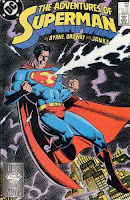
Wonder Woman’s next participation on the grand DCU stage is her big “date” with Superman. Superman, at the time, had been dreaming of the Amazon princess since Legends. Comic creator John Byrne, who was the chief Superman architect since his Man Of Steel reboot, decided to tease the fans with a Superman/Wonder Woman romance. Adventures of Superman #440 (May 1988)
Adventures of Superman #440
Adv. of Superman #440
(May '88)
ends with the two meeting, and Superman immediately engaging with a lip lock worthy of his kiss with Lois in Superman II. That super-smooch directly leads into Action Comics #600 (May 1988), where fans realize that such a romance is not, nor will it ever, be. That issue also marks the change in the title’s format and becomes a weekly book (for the next 42 issues); prior to #600, Action was the designated Superman team-up book since Byrne’s reboot of the character. However, Adventures #440 also was important for another reason.

Superman #1 (Jan '87)
Starting in the rebooted Superman #1, Superman discovers a scrapbook containing press clippings of his earliest exploits; he then proceed to turn the book over to Batman to look into this mystery. The scrapbook, it was discovered, belonged to the Kents, proud parents of the soon-to-be Superman. And really, the scrapbook is irrelevant. However, it is in this issue that Batman learns Superman’s identity. As a result, Superman uses his x-ray vision and peeks behind Batman’s cowl, discovering the vigilante is Bruce Wayne. Four years of activity and knowledge of each other finally led up to this discovery – a first in the post-Crisis DCU. Superman files away and immediately lands in the arms of Diana.

Let’s now get back to Trinity, a story supposedly set during their early careers.

Throughout Trinity, Batman is shown in his gray outfit with the simple black bat insignia. This in itself is not the most glaring of continuity errors. Even though this story should be set in the time where Batman’s costume sported the yellow oval, there are plenty of creators that ignored such detail for what could be looked at as out-of-continuity stories, such as those presented within the Legends of theDark Knight anthology series.

Why should Batman have the yellow oval? Because as of Adventures #440, that was his established costume and that was when the heroes learned each others’ identities. Within Trinity, such secrets are already open as Clark Kent receives a ride from Bruce Wayne.

Another inconsistency is the appearance of Wonder Woman’s invisible plane. When the Wonder Woman title was rebooted, she was granted the ability of flight, so the need for such transport was irrelevant. Wonder Woman’s invisible plane does not make its official post-Crisis appearance until much, much later in the continuity of her title. Again, this can be possibly dismissed with a No-Prize worthy thought along the lines of… maybe the Amazons had it lying around the Diana wanted to take it for a test drive. Right?

An argument could be made that Trinity happens following the team-up in Action #600, after all, this would still be an early adventure as far as Wonder Woman is concerned. The only other allusion to how early an adventure this might be occurs during the heroes’ visit to the Batcave, where a young, dark-haired lad is shown. The boy is never mentioned by name but this could easily be Jason Todd, who was the active Robin at the time.

However, and in spite of all that has been referenced, there is one underlying factor that destroys any sense of continuity: Aquaman.

In issue 3, Batman is racing underwater in a Bat-sub only to encounter – for his first time – Aquaman.
Secret Origins 32
Secret Origins #32
(Nov '88)

Obviously, if Clark and Bruce are already hip to each other’s aliases, Aquaman would have been well established not to mention being a founding member of the Justice League ofAmerica. Aquaman’s appearance eradicates any semblance of post-Legends continuity. Boom. Good-bye. Welcome to the end of the map.

Maybe not all is lost. Let’s look back further then. Perhaps this could be a hidden story from a pre-Crisis Earth-1 detailing one of the first times Superman, Batman, Wonder Woman, and Aquaman, all met. Unfortunately there are continuity errors with that as well. Most noticeably, Bizarro, who is referred to as a clone multiple times. The Bizarro clone was introduced post-Crisis as an attempt for Lex Luthor to gain possession of a completely subservient Superman. In fact, Luthor, who is a corrupt businessman in the post-Crisis DCU, has his LexCorp Tower shown in the pages of Trinity. Yes, the pre-Crisis Bizarro was a Superman “duplicate”, also created by Luthor, but set more in vein as a Frankenstein’s Monster, albeit one who worked everything in reverse.

End result? Trinity is a fun read that is completely ignorant of any sense of continuity and really should have carried the Elseworlds banner, which was a DC imprint allowing top-tier creators, such as Matt Wagner, the opportunity to play with known characters in different, alternate settings. Trinity would have been perfect for this imprint and would have allowed Wagner the freedom push those relational boundaries a lot more than he did.

Trinity is fun, but also probably best forgotten.


As Always,
theJOE

20 November 2017

God 101

Biblical, and using that term generically, texts aside, author-scholar Reza Aslan charts the history – and the concept – of God, providing a fascinating follow-up to Zealot, where he de-constructed and then re-constructed a historical look at Jesus the Messiah. Here, Aslan does not solely present the Jewish/Christian/Muslim God, but theorizes how the idea of “god” is so prevalent with human history; a concept that either most people, devout or not, might have either taken for granted, or simply not have given an origin story much thought. After all, the God of the Big-Three never really required an origin as, in the case with those religions, In The Beginning… God… Right?

Within God: A Human History, Aslan presents a palatable historical journey that traces the idea of God starting from prehistoric times, where an all-encompassing spirit of nature was dominant, to the pantheon of Greek, Roman, and Egyptian gods, to how monotheism became dominant after the Babylonian conquest of Israel, through the birth of Christianity, and finally to the rise of Islam. The pacing skips ahead through history at an outstanding rate. Aslan devotes significant time to the prehistoric concept of God, pointing out the examples of the Trois-Frères caves of southwest France and the stone temple of Göbekli Tepe in Turkey, but then rockets ahead to introduce the God of the Big-Three, yet spends startling little time in referencing why other cultures have been able to follow religious systems, such as Buddhism, without a deity at their center. Rather, he focuses much of his thesis at the idea of a humanized God.

Aslan approaches the topic as subjectively as possible and, as was bluntly noticed in Zealot, does so without the allusion of faith - for the most part. Aslan does present a beautiful illustration in showing that God is akin to a prism of light, where yellow and blue and violet can all be viewed as perspectives change, yet it is all light from the same source. As an open-minded Christian, this is a outlook I have long adhered to and appreciate the back-up in these conservative times. Aslan, however, goes several steps further with his personal enlightenment of pantheism – that “God” is present in all creation at all times and with everyone. This is his explanation on how one god could be capable of both good and evil, as the concept of “god” has been thoroughly humanized and personified. Aslan is committed in his argument, but such beliefs might be seen as heretical with his Christian and Muslim readership, while the less devout might placate such as hippy-dippy baloney.

God: A Human History is successful in showing the importance of God, which is the true underlying factor in tying humanity together.

Many thanks to NetGalley and Random House for the opportunity to read Aslan’s latest and consider this review my recommendation for others. Read it for the history, for the viewpoints, for the opinions, just keep your faith on hand as a bookmark.


As Always,
theJOE

08 November 2017

A Little Too Much

Thomas Mullen certainly gives his readers the service they want with Lightning Men. Building off the previous novel, Darktown, Mullen goes deeper into the plight of Boggs and Smith and their careers as Atlanta’s first African-American police officers. He builds on the story of Officer Denny Rakestraw, a white officer who is not totally opposed to the idea of black officers, but finds himself living in a transition town – white suburbia now threatened to become another Darktown. Mullen’s plot twists and turns with real estate deals, moonshine and marijuana, and tensions between the always-incompetent KKK and their threatening successors, the Colombians. All and this more is breached cover-to-cover in one of the very few times that the old adage once made famous by Sir Mick about too much never being enough is unfortunately not true as Lightning Men suffers from that dreaded curse of sequelitis.

You know, that stigmata is not entirely fair. Lightning Men is a compelling, well-written, and highly entertaining read. Mullen fleshes out 1950s Atlanta and presents the attitude of the city and the blatant bigotry throughout. Mullen digs deeper with his plot, tying various, complicated threads to key characters and letting the reader watch it all unfold. Yet, some of this plot is too obtuse. The map presented sprawls and rambles as long and as wide as Peachtree Street. Maybe Mullen binge watches Game of Thrones and as such, gives too much importance to the B-, C-, and D-story arcs, thus taking away the importance – and the very relevance – of the A-story. Crime novel readers don’t want a ramble down a shady lane in the sun. They want a punch to the gut. Hard punches. With a blow to the nose and a killer uppercut to knock you out. Lightning Men doesn’t have enough punches, but plenty of weaving and feints.

Lightning Men is a worthy follow-up and is successful in structuring, then embellishing, the characters’ arcs. However, too many new characters are introduced and with that comes a level of convenience in working the plot around these new characters and as a result, the story suffers.

Just a little. But just too much.

Yet not enough to keep me away from my next visit to Darktown.


As Always,
theJOE

02 November 2017

Revenge Served Cold

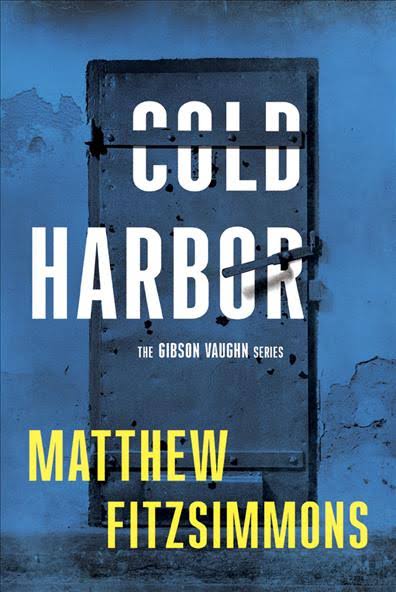
Following the Empire Strikes Back-sized cliffhanger that ended Poisonfeather, Matthew FitzSimmons’ messed-up ex-Marine hacker Gibson Vaughn returns after an eighteen-month absence and is looking for revenge. And although Gibson wants a heaping served ice cold, his thought processes are similarly frozen. His interactions with PTSD-originated ghosts clearly show is not on the top of his game as he was in the debut The Short Drop. FitzSimmons does a fantastic job at getting into Vaughn’s complicated head and makes him sympathetic voice as the reader commiserates with his on-going stress. For all the internal conflict, however, the first act narrative suffers.

If Cold Harbor was season 3 of the Gibson Vaughn drama on FX (and not a bad idea actually, you paying attention Mr. Landgraf?), the network would be hard pressed to ramp up new viewers without the benefit of binge-watching. The novel has a similar circumstance where the familiar reader must fight to play catch up, yet rewards loyal readers to the very end. For someone new coming in who just happens to pick up a copy at the neighborhood Barnes & Noble? Fuhgeddaboudit. FitzSimmons works in backstory and allows a catch-up with the on-going mythos, but initially the reader can be just as confused as the story’s protagonist.

FitzSimmons weaves together action with a hearty bit of internal self-loathing and angst. Gibson’s conversations with his ghosts are not merely metaphorical, but a plot device that, thankfully, does not overstay its welcome, and, contrary to the standard cliché, borders on the detrimental.

Plot-wise, FitzSimmons picks up on the pseudo-cliffhanger from The Short Drop and has Gibson go after the missing George Abe, who was completely MIA during Poisonfeather, while reuniting with cast members from both previous books, strengthening this creator universe. Another strength that gets focus is Vaughn’s humanity and his tendency to doubt, his own fallibility. A hacker by trade, Gibson is by no means the super-genius Cisco Ramon from The Flash, nor do his skills present the ultimate deus ex machina in planned contrivances. He’s good with code, not so much with relationships, and striving to better at both.

Cold Harbor, named for the Blackwater-ish PMC ne’er-do-well, brings a fitting conclusion to the Gibson Vaughn trilogy. FitzSimmons has created a likable character with an enjoyable series. Vaughn is cocky, but knows his limits, more introverted than a one-line joker, and deserves a return engagement. Get working, Matt.


Thanks to NetGalley and Thomas & Mercer for the advance proof, for not only Cold Harbor, but introducing me previously to The Short Drop and Poisonfeather. I have certainly enjoyed the ride.


As Always,
theJOE

09 October 2017

The Greatest American Hero

I finished reading Nancy Schoenberger’s introduction – a well-crafted, passionate account on masculinity from a woman’s perspective, mostly derived through cinematic heroes, such as watching John Wayne westerns, although with the obligatory nods to her father – and immediately turned to my wife stating she had to read this primer. In this world of Wonder Woman and where the glass ceiling is arguably (at least?) scratched, this is the perfect time to hear from a woman on Wayne, who was truly one of those man’s man, like Bogey and Mitchum whose fast-talkin’ wit and sharp muscles fed the ideals of Boomers to Gen X boys nationwide, and John Ford, the man who helped forge Duke’s image.

Like Schoenberger, I grew up on Duke’s film’s and own The Searchers on Blu-Ray for the sole purpose of showing the film to my own boys (full confession: I also have Yojimbo and Hidden Fortress reserved for future viewings as well) but after reading her book I learned that my knowledge only ran as deep as the big hits. Schoenberger goes deeper. Wayne and Ford: The Films, the Friendship and the Forging of an American Hero, Schoenberger avoids presenting a full biography on each man, acknowledging their tales have been told before. Yes, it is impossible to avoid such, but similar to what Bill Shatner recently accomplished in his 2016 recounting of his friendship with Leonard Nimoy in Leonard: My Fifty-Year Friendship with a Remarkable Man, Schoenberger focuses on the often-contentious working relationship between Duke Wayne and Jack Ford and the nearly twenty films they made together.

More than that, Schoenberger provides critical examinations on many of those films, including the aforementioned Searchers, the Cavalry trilogy (Fort Apache, She Wore A Yellow Ribbon, Rio Grande), Stagecoach, as well as Duke’s directorial debut, The Alamo. Schoenberger ponders the essential morality lesson of these films specifically, as well as Westerns generally, and theorizes on the macho image of Hollywood heroes from the more recent past: Gibson, Schwarzenegger, Willis. What do Westerns teach us, she asks and follows up with why are we missing those lessons today?

Their personal lives are accounted for within. Duke’s failed marriages and eventual cancer diagnosis. The possibility of John Ford’s suppressed homosexuality. She asides into separate projects, most noticeably the final three Westerns Wayne filmed without Ford, yet deliberately avoids other independent projects, most noticeably Rio Bravo, one of Duke’s most referenced films. She shows their relationship is more than mentor-student and truly becomes one of father-and-son.

Wayne and Ford is an excellent round-up and review of the work produced by two of the genre’s best. Ford had his Monument Valley. Wayne his stance, his drawl. Both are missed. Wayne and Ford lets you remember and learn.

Thanks to NetGalley and Nan A. Talese for the chance to read and review this enjoyable ARC.


As Always,
theJOE

21 September 2017

Another Countdown to a Different Doomsday

The Batman/Flash crossover is a tease and, like most teases, the end result could have been presented in half of the time, and honestly, with more of a kicker to the ending that, anyone familiar with the origins of Comedian’s button, would have surmised from the beginning.

Looking at that beginning, Batman/Flash: The Button collection excludes the issue/s where the blood-splattered button from the Watchmen series first arrives in the DCU proper. Having the button residing in the Batcave is gospel and has as much needed backstory as that huge T-Rex statue Alfred is constantly dusting. Instead, this crossover provides a fun fight between the Batman and the Reverse Flash that any fan of the Flash’s CW TV show will enjoy, includes an unnecessary visit to the Flashpoint universe that no one really asked for, and is packed with tons of foreshadowing and set up for DC’s upcoming Geoff Johns’ project that is supposed to unite the Watchmen characters with the mainstays from the DCU. Most assuredly, Alan Moore is already spinning in his self-dug grave.

This edition collects two issues apiece from the current runs of both Batman and The Flash. Tom King writes Batman and is paired with artist Jason Fabok, whose art is really what elevates the book. Like the DCEU movie Batman, Fabok’s character is all scruffy and gray, silent and righteous. Fabok  borrows the nine-grid panel layout that the Watchmen made famous, and does justice to the homage. The Flash issues are written by Joshua Williamson, who is both contemporary and safe. Veteran artist Howard Porter provides visuals that are punchy at times, sketchy most others. The work of John Dell, his finisher from their long-time-ago JLA series, is sorely missed.

Throughout the issues, Batman and Flash fight Reverse Flash, run through time, and question the existence of the button without coming to a meaningful conclusion. A Watchmen character makes a kinda-sorta cameo. A tease of the incorporation of a long-standing DC icon fills the epilogue, concluding a tale that is over almost as fast as, well, you-know-who.

This collection is successful from the standpoint that the creators brought forth a product they were commissioned to make: an interesting lead-up for November’s Doomsday Clock. Another Countdown in the DCU, albeit tighter and contained. Another Doomsday, albeit less Kryptonian in origin. Consider me teased.

At least Blue Beetle didn’t die in this one.

A big Bat-thank you to my Flash-friends at NetGalley and DC Comics for the preview ARC.


As Always,
theJOE

19 September 2017

The Weight of the Deal

Adapting a 19th Century Russian fable into a contemporary setting, albeit one 30 some years back in the hey-days of the early eighties, and from a first-time author no less, can be considered a gamble. With Queen Of Spades, Michael Shou-Yung Shum doubles down and beats the house. And as much as I would like for that to be the last gambling metaphor of the review, the speed and tone of the book simply will not allow me to throw down markers on Odd when the roulette wheel will definitely come up Even. Shum, you see, has a way of stacking the deck in his favor.

Set in a unique casino in the Pacific Northwest, Queen Of Spades focuses on a new dealer and his quest to understand the system of Countess, a legend in those parts who only plays the high-stake tables. Shum deals in other players, a dying pit boss, a sad-sack gambler, the ex-wife attending 12-step recovery meetings, a palm-reading teen among others, whose tales are just as unique to that of the dealt hand. More Robert Altman than Woody Allen, although Shum plays tight with themes of both humor and friendship, Shum focuses on his cast of characters, ensuring the prime players are available for the climatic big deal. By the end of that hand, and the read, when all players have called, a few of those folded tales become lost amongst the victory of others, and is a slight problem that is easily forgotten and forgiven.

Shum has a light, easy tone making Queen Of Spades a fun read not only through his narrative, but also as he picks and tempts with the theory of the gamble, the strategy behind the play, and how luck envelops it all.

Many thanks to NetGalley and Forest Avenue Press for dealing me into this well-played round. I feel like a winner.


As Always,
theJOE

07 September 2017

What this Ranger needs is the A-Team

The Ranger is over 300 pages of shady politicians, a suspicious land deal, Neo-Nazi meth dealers, and a gutsy pregnant girl. Ennui settles in around page 40. In fact, it is only the location – rural Mississippi during the cold winter months – that provides any sense of difference as even the title character, Ranger Quinn Colson, doesn’t do much other than brood silently, brag soundly, and eat a fair share of eggs and ham. And if anything, that is exactly what The Ranger needed more of: ham with a healthy side of cheese. Instead, all we get is dry toast.  

Ace Atkins provides his natural take on the surroundings, the environment, the establishment of characters,  yet he doesn’t get any deeper than that. Colson is the typical silent type who is wound so tightly he is incapable of any action that doesn’t come by way of orders from some CO while out on patrol in Nowheresistan. His lone friend is a Stand By Me good ole boy who doesn’t get any characterization outside of his initial introduction. The villains are predictable. The backstabbing inevitable. Even the high noon showdown is wrapped up in a scant two or three pages with the cavalry’s arrival feeling more Appaloosa-slow than some needed over-the-top-ness ala The A-Team.

The hillbilly/redneck justice genre can be a real hootnanny. Shoot, even good old-fashioned western-style revenge tales get the blood a’flowin’ and the pages a’turnin’. The Ranger is a series of stop-and-starts, of teases and foundation laying. The good boy grimaces and bad guy postulating within has all the uniformity of Barry Manilow when what you really want is the spontaneity of James Brown. Or the A-Team. 


As Always,
theJOE

31 August 2017

Dope

Icarus, much like its mythological namesake, starts out openly enough. Writer/director Bryan Fogel, obviously undergoing a mid-life crisis, seeks to rise above his competition and win an long-eluded amateur bike race by subscribing to a doping program ala Lance Armstrong and Tyler Hamilton. His gonzo-ish film about cheating the system then takes a serious turn as he flies extremely close to the sun by becoming involved with Russian doping superstar, Grigory Rodchenkov, just prior to the 2016 summer Olympics and Russian scandal – the doping scandal that is, taking into consideration another very serious scandal that occurred in the United States later that year in November, an event this film alludes to.

Fogel’s film presents a complete analysis of Russia’s athletic doping program and its pervasive influence on all of its athletes while providing a revealing look at how the conspiracy came to light leading to the eventual banning of 68 Russian athletes from Rio. The documentary is so compelling you cannot look away.

Rodchenkov, who comes across as a favorite crazy uncle, blasts away on camera with truths and proofs that lead to WADA and the IOC’s landmark decision. Rodchenkov equally has no problems with broadcasting his opinions concerning President Vladimir Putin’s fear-laden regime. If Putin and the KGB can easily evade the IOC, imagine what other high-level larceny exists that can be used to, ahem, trump other standards.

Icarus presents art dictating life, where one rather flaky story uncovers a very-real conspiracy that affects so many. This is not merely a sports documentary, rather a politically human one with real consequences, and needs to be viewed. Here’s hoping the Academy’s nomination committee is taking note, as Icarus has the potential to win gold of its own.


As Always,
theJOE

30 August 2017

Not the Freshest Affair

There is no denying that Nelson DeMille is a master of action, thrillers, and debatably-good one-liners. He also makes for a rather good globetrotter reporting on locales that the normal traveler probably doesn’t have at the top of their bucket list: Russia, Yemen, and now, Cuba. However, the one problem with niche writers is that their beloved style can sometimes be encapsulating. New stories might be enjoyable, neo-noir reads, but are not necessary the freshest.

The Cuban Affair, DeMille’s latest, drops Daniel "Mac" MacCormick, ex-Ranger now sea captain, directly into the Obama-era “Cuban Thaw” where he is hired to help Cuban dissidents in recovering pre-Castro property deeds, and maybe a whole ton of cash, all while trying to escape from Havana. Mac is a fun, archetypal DeMille alpha male. He prefers beer to wine, one-liners to pillow-talk, and has the libido of a seventeen-year-old. Mac is a good guy, and someone you would want on your side in a fight. Or a good game of cornhole. Yet, he is hardly original. In fact, the name “Daniel MacCormick” could easily be replaced with DeMille regulars “John Corey” or “John Sutter” and aside from environment settings, no one would be the wiser.

DeMille, of course, knows his audience and easily provides that which has made him popular. The Cuban Affair is a fun, thankfully-fast read that allows DeMille to postulate Cuba’s place in the current global community while making sure good ole Communism is still the go-to baddie as the CIA remains the slightly lesser of two evils. As original as the Caribbean setting is, the infiltrate-and-escape plot is certainly not. DeMille peppers the chase with fun characters and clever dialogue, but even that only has the appeal of a Corona Light, when the long-time fan is thirsty for a cuba libre. Right?


Many thanks to Simon & Schuster and NetGalley for the ARC, as well as to Nelson DeMille, who remains one of my favorite authors and whom I would share a Corona with anytime.


As Always,
theJOE