Along with the
built-in worldwide adoration, actors during Hollywood’s Golden Years apparently
had immediate and abundant access to booze, drugs, and illicit women, all of
which was enjoyed at a premium. Woe, however, to the john caught, for if the
studio’s fixer couldn’t provide an out, the mob would, particularly with a
bullet, knife, and/or noose. At, least this is all hypothetical according to
Guy Bolton and his debut crime noir novel, The Pictures, which is a
piece of fiction. Right?
Bolton gives credit to
Hammett, Cain, and Chandler in the book’s acknowledgments, and rightly so, as
his writing style is a perfect complement to that powerhouse triumvirate of
hard boiled fiction. Bolton takes that inspiration and presents a tale of
yesteryear that is startling fresh as he plays with the many contradictions LA
has to offer. The bright lights and dark streets. Movie magic and seedy deals.
Fast, loud action and slow, strangling death. The pre-war hip vibe of the
haves, and the sweltering soup lines for the have-nots.
Set in 1939 during the
production of The Wizard Of Oz, Hollywood detective Jonathan
Craine, the LAPD’s “fixer” for keeping the studios’, especially MGM’s, talent
in line, and rookie detective Patrick O’Neill are assigned to the seemingly
unrelated deaths of one of the film’s producers, as well as that of a
model. Craine is a stalwart, loner of a cop, who would much rather sign
off on case then performing an in-depth investigation. MGM helps support
Craine’s lifestyle – his evenings to the top clubs, his fast car, and, oh yeah,
his dead actress wife – and wants the case closed with zero publicity. O’Neill,
however, is eager to make his mark with all eyes dotted and tees slashed. And
if that doesn’t bring to surface a smooth homage of Elroy’s LA
Confidential, then The Pictures is not the genre read for
you. But it should be.
Bolton provides a read
that feels like an MGM production complete with an incredibly-easy imagining of
Bogie in the role of Craine, or, for a more modern interpretation, Kevin Spacy,
with Guy Pierce in for O’Neill. Within The Pictures, whiskey is
always single-malt, Chesterfields are inhaled everywhere by everyone, and
murder is still the ultimate taboo. The constant is that crime does not pay.
Might get the occasional comp, possibly a long-ish holiday, but if Cain taught
us, and ultimately Bolton, anything is that the postman always rings twice. For
The Pictures, that happens to
Jonathan Caine. Hollywood is his beat. He carries a badge. And we are along for
the ride.
As Always,
theJOE
05 August 2018
02 August 2018
Extinction... and not for the last time, either
The alien invasion plot is an industry standard that is now as boilerplate as Batman’s origin and Netflix’s Extinction upholds this formula in a by-the-books thriller yet manages to present the film in a slick and entertaining way. Yes, there is a plot twist deep in the third act that is satisfying and, believe it or not, even a little surprising, which helps provide an explanation in a Marvel No-Prize sort of way for the rather stilted performance from a usually affable Michael Pena.For all of the standardization this film brings, such as video-game quality f/x and aliens that look like extras from the set of Doctor Who, Extinction does succeed with showcasing the family dynamic during wartime. Pena’s Peter is not a macho alpha male who goes all John McClane when the bullets start a’flying, but instead pauses, and thinks; he plans on how to get his family to survive. His actions are believable and are truly what makes an average direct-release sci-fi flick all the more enjoyable.
Plus, Sweet Christmas, Luke Cage guest stars.
As Always,
theJOE
13 July 2018
Ohio
Ohio begins
with a funeral and ends in murder. What happens in between is as depressing as
a high school reunion, but man, Stephen Markley’s writing elevates the
wrist-slashing fatigue into a Stanley Kubrick-like, art-house style circa Clockwork Orange. Still, Ohio is 500-page work that feels like it
takes all four years of the riding the after-activities bus route to read
through.
Markley recounts the impromptu high school reunion of 2013 following the
incredibly-pitiful-it’s-laughable funeral of fallen solider Rick Brinkland as
told through the antics and mostly-troubled thoughts of four New Canaan alum,
each getting a novella to tell their tales of woes: of trying to fit in, on
being attracted to the wrong gal or guy, running away from responsibility, and
the youthful persistence of taking the moral high road. After all, if Kevin
Smith’s Clerks taught us anything, it’s
that’s what high school is all about: algebra, bad lunch, and infidelity. Markley
would add “with a ton of drugs” to that statement as apparently that’s all early
21st century kids in the Rust Belt seem to do. Ohio captures all of that and more. Sometimes, that’s too much.
Like its namesake river and the first ten years of the Columbus Blue Jackets’ existence, Ohio rambles on and becomes unwieldy. Markley’s accounts run so deep an Excel spreadsheet is needed to capture the dramatis personae, their nicknames, associates, sexual partners, and addiction of choice, because there is four years’ of catch up required for the reader while the story’s hook, that of the murder mystery, comes so late in the final act it’s nearly a post-credits zinger in a Marvel Studios film.
Aside from the back-and-forth storytelling told by a former basketball player, a beauty queen, a cheerleader, and a nerd, Markley builds a heavy universe, and one that is completely recognizable as anywhere in America and has the scars to prove it. Ohio may be depressing and fatalistic, but Markley’s craft brings a shine to this Shinola and casts a sense of importance to any of the fatalism plaguing fulfillment-seeking millennials. Unfortunately, this nine-course meal version of a history lesson suffers from distention well before any sort of a hopeful moral can be splashed back with Scotch.
Serious thanks to NetGalley and Simon & Schuster for the ARC. I just need a restorative nap and a mini-marathon of Teen Titans Go! for the laughs and I’ll be good to go.
As Always,
theJOE
03 July 2018
The Colorado Kid
Hey Kids! Want to read about an unexplained mystery as told by two very old New
England reporters in a meandering style similar to how your grandfather used to
go on about his ’64 Chevy pick-up? Then break out the Coca-Colas and switch on
the Mr. Coffee, Uncle Stevie has a book for you.
To be fair, The Colorado Kid is not quite that discouraging. The true narrative of this book, which slightly deceptive, is more about the craft of the story then the, as mentioned within the tale’s journalistic jargon, feature thru-line. This is also King’s love-letter to old-fashioned reporting as well as a chance to back up the treatise laid out in his memoir On Writing, which is a book any lover of stories, let alone those told by King, should have in their library. The Colorado Kid, however, can at best be settled on as a borrowed rental.
The Colorado King has old men Dave and Vince, islanders from birth, pass on their newspaper torch to their flat-earthed intern Stephanie, who has raw talent in need of honing. King cleverly, and ploddingly, explores the nature of telling a mystery, as opposed to actually solving the damn thing. Stephanie plays the role of the everyman/woman as King takes his time through the codgers at hand, to lay out the mystery – a dead man discovered on an island beach off the coast of Maine, no ID, save for a pack of cigarettes purchased in Colorado – and gives the reader, through Stephanie, the ability to play catch-up, to give life to what should be a dead story, to fill in the Ws for all the Qs, while learning they don’t always line up to a perfect A. The purpose of a story is that it needs to be told, and not always with a happy ending, which is what happens here. Yet, that story does need to be compelling and the main one here, that of Stephanie’s youth and eagerness, should have been the road explored, and not the well-worn paths of two men trailing off into the twilight. King, however, acting as the spokes piece, deserves that attention of an elder statesman and makes an even somewhat rote tale entertaining. Now pass me a cuppa coffee, willya? Uncle Stevie has more to tell.
As Always,
theJOE
19 June 2018
Thrill Girl
Curran, working with a pseudonym, places himself in the story as a reporter looking into the vigilante known as Thrill Girl. He wants to get the As for all the Qs, or at least all the journalistic Ws surrounding this woman. Is she a hero? Or a threat? A typical femme fatale, or a beauty who’s a beast? Curran, the reporter, works through the story as Curran, the author, cleverly reveals pieces of the mystery at the right times. The wrong times are what drags the tale down. The dialogue can be plain jane dull as are frequent scene set ups. Curran might have the right recipe, but needs to work on the flavor. Missing is the quick rat-a-tat pulse of a Chandler or the immoral vulgarity of Elroy. Thrill Girl could be Glenfiddich instead of Old Grandad.
What Curran might lack in style, he rips right ahead with plot, and in all honesty, makes the read entertainingly fun. The mystery is tight and remains good to the last drop. And Curran the reporter, is actually a good egg, one you don’t want to see crack on a desolate alleyway in old-time Hollywood.
Many thanks to NetGalley for the advance edition and the hard-boiled fun.
As Always,
theJOE
01 June 2018
Slugfest: Marvel vs DC
Looking back on 50 years of comic book history, Reed Tucker unleashes his story of the ultimate cosmic combat where punches and fights and battles were not limited to the four-color world of super-heroes and god-like deities, but instead happened between the editors and creators of the two biggest and best of comic book champions: Marvel and DC.
Slugfest: Inside the Epic, 50-year Battle between Marvel and DC meticulously compiles hundreds of interviews and creates a narrative for the fanboy ages that is as entertaining as it is sometimes embarrassing. Similar in scope to Marvel Comics: The Untold History by Sean Howe, Slugfest parallels the rise and fall and rise and fall again of these titans of industry. Tucker gets into the moving parts of both offices, the reigns and fiefdoms established by editor-in-chiefs, and their constant bickering and one-upmanship. However, Tucker’s seemingly Marvel-slanted bias is underlying in the narrative.
Throughout Slugfest, Tucker constantly places the stoic and established DC up against Marvel, who is eternally portrayed as the scrappy underdog. Even when Marvel finally becomes Number One in the industry, these two motifs never change in the book, even though, as a fan of comics in the eighties and nineties, such a paradigm shift did indeed happen. DC Comics, properly recognizing the success of The Dark Knight Returns, and Watchmen, and Swamp Thing and Sandman, jumped full-force into adult-oriented comics and completely owned that particular market, a fact that Marvel was never able to accomplish, as industry-recognized awards can verify. Slugfest glances over such details, presenting instead overall company sales percentages.
Naturally, as a comic book fan, there are many points where the book could have gone deeper, from Jim Shooter’s firing at Marvel to DC’s acquisition of the Charleton Comics line, how the creation of Image changed the status-quo for creator-owned series, and the wrangling of established writers from outside the industry. The largest slight missed in Slugfest is that of the fan’s perspective. As a fan and one-time avid reader of both companies, I never bothered with what was the top-selling comic and who reigned the charts. I cared about the actual product. And for a long time in the late eighties and into the nineties, there was a constant every fan knew: Marvel had the artists, but DC had the writers. DC was the place if you cared about a story and a character’s arc, while Marvel zombies were delighted with eye-candy spectacles. After all, DC never released a swimsuit special. Right?
Slugfest is a fun, recommended read, and completely relevant for today’s market where, the comic titles themselves be damned, Marvel dominates the cinema, yet DC TV is, well, scrappy and entertaining. Tucker’s account of it all is a treat, well establishing the fact that the true victor of any such conflict is the fan, who can watch the combat unfold, the sparks fly, the punches thrown, and read stories that remain yet untold.
As Always,
theJOE
Slugfest: Inside the Epic, 50-year Battle between Marvel and DC meticulously compiles hundreds of interviews and creates a narrative for the fanboy ages that is as entertaining as it is sometimes embarrassing. Similar in scope to Marvel Comics: The Untold History by Sean Howe, Slugfest parallels the rise and fall and rise and fall again of these titans of industry. Tucker gets into the moving parts of both offices, the reigns and fiefdoms established by editor-in-chiefs, and their constant bickering and one-upmanship. However, Tucker’s seemingly Marvel-slanted bias is underlying in the narrative.Throughout Slugfest, Tucker constantly places the stoic and established DC up against Marvel, who is eternally portrayed as the scrappy underdog. Even when Marvel finally becomes Number One in the industry, these two motifs never change in the book, even though, as a fan of comics in the eighties and nineties, such a paradigm shift did indeed happen. DC Comics, properly recognizing the success of The Dark Knight Returns, and Watchmen, and Swamp Thing and Sandman, jumped full-force into adult-oriented comics and completely owned that particular market, a fact that Marvel was never able to accomplish, as industry-recognized awards can verify. Slugfest glances over such details, presenting instead overall company sales percentages.
Naturally, as a comic book fan, there are many points where the book could have gone deeper, from Jim Shooter’s firing at Marvel to DC’s acquisition of the Charleton Comics line, how the creation of Image changed the status-quo for creator-owned series, and the wrangling of established writers from outside the industry. The largest slight missed in Slugfest is that of the fan’s perspective. As a fan and one-time avid reader of both companies, I never bothered with what was the top-selling comic and who reigned the charts. I cared about the actual product. And for a long time in the late eighties and into the nineties, there was a constant every fan knew: Marvel had the artists, but DC had the writers. DC was the place if you cared about a story and a character’s arc, while Marvel zombies were delighted with eye-candy spectacles. After all, DC never released a swimsuit special. Right?
Slugfest is a fun, recommended read, and completely relevant for today’s market where, the comic titles themselves be damned, Marvel dominates the cinema, yet DC TV is, well, scrappy and entertaining. Tucker’s account of it all is a treat, well establishing the fact that the true victor of any such conflict is the fan, who can watch the combat unfold, the sparks fly, the punches thrown, and read stories that remain yet untold.
As Always,
theJOE
29 May 2018
ANON: SciFi blast for cliché crime caper
Clive Owen stars as a detective in a nameless city under a perpetually gray twilight sky who has access to these personal, individual records. He’s a gruff, tired-looking cop who smokes (so hey, at least that vice is still around in the near future) as much as he plays voyeur into his, as well others’, memories. However, hackers who work off the grid can be paid in order to edit, thus hide, certain memories. One hacker has taken to killing such individuals and Owen is tasked to stop the murderer.
Anon, played by Amanda Seyfried, is a hip hi-tech cat that proves her prowess by slowly hacking into Owen’s own visuals, distorting what he is seeing, be that a clear intersection that is actually jamming, or an empty elevator car instead of an empty elevator shaft. The tech premise is extraordinary, tempering the best of what science-fiction at its core is supposed to offer, as the presented threat is real and believable.
Alas, all good science fiction does have its limits, as does Anon, and this neo-noir thriller exposes its fatal flaws in the programming. Once this world and its technology have been explored to its limits, the crime element of the narrative forgoes all its collective coolness resulting in a typical whodunnit-style mystery that fizzles into a who-cares climax. Owen makes a good cop, but apparently gumshoe clichés, like tobacco and the vintage cars driving throughout, remain woefully relevant. Maybe the true magic lies ahead in allowing rogue editor to hack together a more fitting finale.
As Always,
theJOE
23 May 2018
The Sisters Brothers
The American West of the 1850s is allotted to history as
wild, gritty, untamed, and messy. According to Patrick DeWitt, it is also,
well, quirky, at least concerning his picaresque characters, the titular
hombres that make up The Sisters Brothers.
Eli and Charlie Sister are two assassins sent by their
boss, the Commodore, to commit murder most foul on one Herman Kermit Warm, who,
as the job at hand is slowly questioned, might not warrant such an exacting
fate. The brothers are committed, if routine, and take to the task like one
would fry up the morning bacon.
Random peculiarities occur along the way during this road trip of a novel. Eli and Charlie encounter one bizarre situation after another, but nothing comes of such meetings other than the portrayal of a quirky story that would make Wes Anderson smile. Each meet – a weeping man, a prospector who brews dirt in lieu of coffee, and questionably-pointless intermissions with a little girl – is entirely accidental and meaningless in the overall scope of the narrative other than DeWitt wanting the reader to understand that anything can happen in such a setting. Fortunately, the dialogue and craftiness of the formal politeness presented in the overall speech and tone is what makes the novel an enjoyable read. The tale is odd with its laced-in satire that is never entirely funny, nor is it deadly serious, even when dealing with the job of death. DeWitt keeps you firmly saddle-bound through the expanse of the story, and the lives of the brothers through to the nearly anti-climactic ending of base resignation.
Slow and as rambling as a cattle drive at points, DeWitt plays with the Western convention while wrangling up a unique vision. The obligatory shoot-outs occur, but not when expected, and perhaps not often enough. After all, there’s treasure to be found in them there hills, and hot lead is not a substitute for cold gold. Right? DeWitt questions that value and explores the boundaries of the lives that rate such a cost.
As Always,
theJOE
Eli and Charlie Sister are two assassins sent by their
boss, the Commodore, to commit murder most foul on one Herman Kermit Warm, who,
as the job at hand is slowly questioned, might not warrant such an exacting
fate. The brothers are committed, if routine, and take to the task like one
would fry up the morning bacon.Random peculiarities occur along the way during this road trip of a novel. Eli and Charlie encounter one bizarre situation after another, but nothing comes of such meetings other than the portrayal of a quirky story that would make Wes Anderson smile. Each meet – a weeping man, a prospector who brews dirt in lieu of coffee, and questionably-pointless intermissions with a little girl – is entirely accidental and meaningless in the overall scope of the narrative other than DeWitt wanting the reader to understand that anything can happen in such a setting. Fortunately, the dialogue and craftiness of the formal politeness presented in the overall speech and tone is what makes the novel an enjoyable read. The tale is odd with its laced-in satire that is never entirely funny, nor is it deadly serious, even when dealing with the job of death. DeWitt keeps you firmly saddle-bound through the expanse of the story, and the lives of the brothers through to the nearly anti-climactic ending of base resignation.
Slow and as rambling as a cattle drive at points, DeWitt plays with the Western convention while wrangling up a unique vision. The obligatory shoot-outs occur, but not when expected, and perhaps not often enough. After all, there’s treasure to be found in them there hills, and hot lead is not a substitute for cold gold. Right? DeWitt questions that value and explores the boundaries of the lives that rate such a cost.
As Always,
theJOE
27 April 2018
The Bigger Picture
Ben Fritz of the Wall
Street Journal loves movies. He is passionate about the experience of
communally watching a film, the unique ability for artists to tell their
stories, and the Hollywood business machine behind it all. But man, he hates
franchise features. From Marvel and DC to Star Wars and Star Trek to dinosaurs
and robots, he sees these spectacles as indie film destroyers and creative
blockers. To some extent, he might be right. What Fritz seems to have forgotten
along the way, and a point that is only marginally made during the wrap-up of
his book The Big Picture, is that movies, yes, even those about
super-heroes and Jedis, are supposed to elicit an emotional response, be that
enjoyable, fun, or even disturbing. The Big Picture is an
important, topical,
timely read, and one that can be quite depressing at times in regards to the state of the industry, and with that fact that he just can’t get over that super-hero hurtle.
Fritz focuses his book on the parallel fall of both Sony Pictures and of mid-budget adult dramas industry-wide. Taking advantage of 2014’s hack, Fritz provides incredible insight into the studio that, honestly, never could have happened if that hack did not occur. The book runs with a documentary style narrative on Amy Pascal, Michael Lynton, and Sony’s quest to remain as an actor-friendly studio in an era where big-budget franchises quickly became the rage of the machine, and at a time when Sony had one, single franchise, that surprisingly couldn’t compete: Spider-Man. Fritz’s on-going commentary, about how the franchises being overseen by the Disney umbrella (incorporating Marvel, Lucasfilm and Pixar), Warner Bros, and Fox propelled those studios ahead of the others by incredible margins with arguably less creativity, however, quickly becomes repetitive. He’s a voice in the wilderness screaming for common sense and a return to artistic measures, but one that is being smothered by the mass of fanboys, geeks, wizards, and Disney princess consumers.
But what if today’s current state is not all bad? Yes, studios have pared down their offerings, but what if in doing so, they are making better films? Creative films with substance guided by an artistic venture and not a committee? Fritz breaks down the financials of how a film like Steve Jobs may or may not make a profit and expands that equation to the first Spider-Man film by Sam Raimi. Yet he never scores an interview with an actor or director who made it big, and whose work benefited as a result of being in such a franchise. An artist, like Jon Watts who, regardless of making Cop Car, might never have achieved a grand success were it not for Spider-Man: Homecoming, or an actor such as John Boyega getting his huge break with The Force Awakens.
As part of those financials, Fritz gets into the former importance of DVD sales, and how the loss of that income was instrumental into the disappearance of mid-range fare. VOD and direct-release methods were discussed as alternatives, but financials on digital purchases and rentals were not given any viable notice. And perhaps it is still too early for analytics on such info. However, can it not be said that the successes of the X-Men and Deadpool films can directly lead into allowing studios, such as Fox, to release The Shape of Water and Three Billboards Outside Ebbing, Missouri? Fritz only makes tangible connections.
Look, I am an indie film snob. I’m the guy hitting film festivals to see the latest from Jim Jarmusch and Wes Anderson while boycotting Michael Bay nonsense and Seth MacFarlane comedies. I prefer those serious dramas that compel thought and analyzation, to experience that fresh creative vibe. But man, the geek in me eats away at Marvel, Star Wars and Star Trek, franchises that I will defend as much as I love Bottle Rocket and Ghost Dog. I think there can be such compromise between art and commercialism. I think that if people are going to the cinema, even if it’s, ugh, Sausage Party, then the medium is being absorbed, and propagated. And that should be considered a win.
The Big Picture is a good read and a fantastic insider’s look into the studio system. However, the removal of the constant commentary could have reduced this repetitive-at-times read from a full book to a powerful article in the New Yorker.
Many thanks to Houghton Mifflin Harcourt and NetGalley for the advance reader’s copy. I find it deliciously ironic that I am writing this review on the eve of possibly the greatest franchise release of all time: Avengers: Infinity War. I have tickets for Saturday’s show.
As Always,
theJOE
Labels:
Avengers,
Ben Fritz,
Fox,
Jim Jarmusch,
Lucasfilm,
Marvel,
Movies,
NetGalley,
Pixar,
Sam Raimi,
Sony,
Spider-Man,
Star Trek,
Star Wars,
Steve Jobs,
Wall St,
Wes Anderson
24 April 2018
When the Omega Point Breaks
Point Omega is Don DeLillo’s exercise in drinking scotch
neat and slowly discussing loss, without ever directly mentioning such. Until
it happens. And maybe not even then. With DeLillo’s glacier-moving plot, loss
is the only event that occurs in a book that focuses on two men: one old, and
one getting there. They talk like old men. Drink like old men. Slowly.
Repetitively. Discussing. Dissecting. Thinking. At certain beats, what thoughts
indeed.
Yet, yes and yet, as a lover of stories, this one doesn’t
go anywhere. The arrival, and subsequent departure, of Elster’s daughter
Jessie, is the only element denoting time moving forward, as the two men are
stuck in their own two fps lives. Ideas are discussed, dreams are forgotten,
and again yet, there isn’t any true development for them as the lack of a
narrative-heavy arc prevents any true catharsis or evolution. Then the book
simply ends, leaving the men stuck in the inconsequence of their own inaction.
To be watched, frame by frame, with no resolution in sight.
DeLillo slows down time, deliberately, stunningly.
Bookended with an elaborate depiction of Douglas Gordon's film project 24 Hour
Psycho, in which the classic Hitchcock film is reduced to play at two frames
per second, DeLillo slows the lives of Elster, a former military analyst, and
Finley, a wannabe filmmaker, stretching out their time into a series of blurred
together sun rises and sets. Their discussion works. The reader yearns for that
next conversation particularly from Elster, his theories, his philosophy; he sees war as a haiku.
Intellectually deep and mono/dialogue heavy – this is good stuff.
Yet, yes and yet, as a lover of stories, this one doesn’t
go anywhere. The arrival, and subsequent departure, of Elster’s daughter
Jessie, is the only element denoting time moving forward, as the two men are
stuck in their own two fps lives. Ideas are discussed, dreams are forgotten,
and again yet, there isn’t any true development for them as the lack of a
narrative-heavy arc prevents any true catharsis or evolution. Then the book
simply ends, leaving the men stuck in the inconsequence of their own inaction.
To be watched, frame by frame, with no resolution in sight.
As Always,
theJOE
19 April 2018
Playing With Madness
Run to the hills, Maiden fans. Front-man Bruce Dickinson’s
autobiography What Does This Button Do? is fun, relatable, and likable, just
like the rock deity himself. Bruce is, after all, a different sort of heavy metal
artist, so there is no reason why his book should also not be equally unique.
Alongside the tales of an international rock star with travels to Sarajevo,
Japan, Rio, Australia, and, heaven forbid, Detroit, Bruce is a brew master, a
fencing master, an actor, and, oh yes, an airline pilot. In fact, with a large
portion of his book devoted to his extensive pilot’s training, his enthusiasm
of flying, and details of all types of planes, his family life is as silent and
forgotten as unclaimed luggage.Autobiographies, particularly those belonging to rock stars, are often filled with the cliched travels and travails of life on the road: cheap hotels, roadside bars, one-night stands, sex, drugs, and, occasionally, a little rock-n-roll magic. Surprisingly, not so much for Bruce and his time in Iron Maiden or even his solo career. Yes, yes, there are the typical hot tub parties and experimentation with hallucinogenic wacky weed within, but for the most part, Bruce lived a straight life, putting all his passion onto the stage, and then later, into the pilot’s seat.
Always a performer, Bruce’s recounts are refreshing and entertaining. Even during chapters discussing a crushingly-depressing tour to Sarajevo during the height of the Balkan war, and his, thank Eddie, recovery from cancer, his style is open and welcoming. Although mostly linear, the narrative occasionally jumps around at times like an excited teenager anxious to talk about a cool concert or blockbuster movie. Again, and deliberately, Bruce foregoes any mention of his love life; his wives, his children. In his afterword he mentions this book is his tale to tell, and gives his family as much privacy as possible. However, such absences do make significant holes in his timeline.
The best of autobiographies are when the reader feels like the author is speaking to them directly while sharing space at a bar. Bruce does not disappoint. Tragic, engaging, and, real, Bruce is the real deal and enjoys the respect of his fans. Although, I’m sure he’d prefer it if you were drinking a pint of Trooper ale.
As Always,
theJOE
13 April 2018
Change is Good
Hockey, for the
casual fan – the guy who catches the highlights while at the bowling alley bar
or tunes in for a period when the local team hits the playoffs – can be defined
by one all-encompassing element of play: the fight.
That diehard fan? Fighting, save for the occasional benches-clearing melee that lasts the entire third period (like that unforgettable Flyers/Senators brawl from 2004), is passé and even a time waster. For the diehard, it’s all about the speed, the slapshot, the butterfly save, the hat trick. The play and the score is what truly matters. And Ken Dryden, former Montreal Canadiens goalie and Maple Leafs president, now author, would agree. With his latest, Game Change, Dryden skates deep into another issue: concussions that come as a result of body checking, and yes, fighting.
Game Change is an entertaining, enlightening read. The book is also an important one, and topically so. In Game Change, Dryden explores the life and career of Steve Montador, an everyman defenseman who played for six NHL teams and whose career ended as a result of multiple concussions. Montador died in 2015 after suffering from the effects of chronic traumatic encephalopathy, a degenerative brain disease commonly known as CTE, an acronym anyone who saw the Will Smith movie Concussion should recall.
Dryden cleverly disguises his treatise with an enjoyable look into hockey history, how the game started, and how it has evolved. Within is also Montador’s story: how he played, how he trained, and most importantly, how he loved the game. Yet, similar to the fighters and goons of the game, Dryden does not pull any punches as he throws down his gloves to present his call to arms: no hits to the head. No excuses.
Dryden writes like a hockey player. His sentences are short and clipped, he often repeats highlights he finds important to ensure the reader takes notice. He is also passionate, writing from the heart, even when he is taking about the mind. To do so, he presents interviews not only from scientists and doctors who share his philosophy of changing – and only slightly at that – the game of hockey to preserve the quality of life for the player, but also talks to players. Former Bruin Marc Savard, Flyers captain Keith Primeau, and someone named Sidney Crosby all share their stories and fears and recovery from post-concussion syndrome, how it has changed their play, and their lives.
Game Change is written for the casual fan, but the diehard will enjoy the deep cuts. More importantly, and even more important than hockey, the respect for life offered within is shown as a universal constant. That players, with their athleticism, their passion, their talent, are much more than just a product. Theirs is a life that should be cherished and celebrated. Dryden believes that is a constant on which everyone can agree. Unless, of course, you are NHL commissioner Gary Bettman.
As Always,
theJOE
30 March 2018
100 Silver Bullets
Let’s hear it for comic book vets taking a bite outta
originality. New York gangsters with Tommy guns and spats go up against
Appalachian hillbillies and their missing teeth for remarkably distilled hooch
during Prohibition. And oh yeah, there’s a werewolf or three out there on the
prowl going all Gary Brandner because, man, this is comics!
Brian Azzarello excels – in short bursts – when working
within the crime genre. His plots are quick, at times convenient, and his
dialogue rat-a-tat fun as his work on Jonny Double and the first two-ish years
of 100 Bullets can attest to. With Moonshine, his double entendre is as fun as
his characters are cliché, completely fitting the bill for an Edward Robinson
meets Lon Chaney, Jr mash-up. Eduardo Risso is never finer then when drawing a
femme fatale or a Ford Model A, and he gets the chance to showcase both, along
with a bunch of shadows, negative space, and man, that full moon, throughout
this first volume.
Moonshine tells the tale of Lou Pirlo and how he gets caught in the world of, well, moonshine and, in a way, silver bullets. Written in a noir style, Lou quickly realizes he is in trouble and completely out of his New York state of mind. He’s drowning while gulping down every last drop of that nectar. Azzarello builds on the mystery while Risso paints trees of orange and rivers of red – along with the requisite shoot-em-ups.
Yeah. Good stuff. Tons of fun that will hopefully never become a show on HBO.
As Always,
theJOE
29 March 2018
It's war, I tell ya!
Author Omar El Akkad imagines in his first novel how the
ravages of the Second American Civil War separate a late 21st Century America
and divide its people. From a premise, and with that war as an intriguing
backdrop, American War moves beyond the dystopian stories that are all the rage
and presents a believable time, where climate change has altered the map, and
made proud Southerners refugees in their own nation. El Akkad has a beautiful
writing style and digs deep into presenting the future as history. Unfortunately the narrative doesn’t hold up
as strong, becoming an exile within its own prophetic stance.
American War tells the tale of Sarat Chestnut, who
becomes a revolutionary for her people, although the majority of her “people”
never ask her to step up, don’t exactly understand the need of a hero, nor are
they in the mood, aside from other self-entitled revolutionaries who seek to
propagate the war for the sake of simply fighting, to enshrine one. Which
brings forth the question: what is the investment for the reader? El Akkad is
extremely obtuse in supplying an answer.
El Akkad, born in Egypt, and raised in Qatar, definitely possesses a unique view of Americans and the whole mom-and-apple-pie way of life. His time as a journalist helps extend his unique, and believable, setting, complete with all its ideologies and theologies but cementing in the proof that violence begets violence and brother, that’s all Sarat is. And that is her downfall as a character. She is not provided with the chance to be cherished. She becomes a tool of an obtuse agency and is set on her way going through a series of challenges and torture that has been seen before, and handled better.
The tale of Sarat is bookended by the narration of her nephew, who obviously loves his aunt and understands her cause. She is the one he worships when all others have turned away. He presents her life as one being worthy, one with reason. And that is the story this book should have been.
As Always,
theJOE
American War tells the tale of Sarat Chestnut, who
becomes a revolutionary for her people, although the majority of her “people”
never ask her to step up, don’t exactly understand the need of a hero, nor are
they in the mood, aside from other self-entitled revolutionaries who seek to
propagate the war for the sake of simply fighting, to enshrine one. Which
brings forth the question: what is the investment for the reader? El Akkad is
extremely obtuse in supplying an answer.El Akkad, born in Egypt, and raised in Qatar, definitely possesses a unique view of Americans and the whole mom-and-apple-pie way of life. His time as a journalist helps extend his unique, and believable, setting, complete with all its ideologies and theologies but cementing in the proof that violence begets violence and brother, that’s all Sarat is. And that is her downfall as a character. She is not provided with the chance to be cherished. She becomes a tool of an obtuse agency and is set on her way going through a series of challenges and torture that has been seen before, and handled better.
The tale of Sarat is bookended by the narration of her nephew, who obviously loves his aunt and understands her cause. She is the one he worships when all others have turned away. He presents her life as one being worthy, one with reason. And that is the story this book should have been.
As Always,
theJOE
07 March 2018
Escapism
New York Times best-selling author Brad Meltzer returns
with his latest thriller that easily contains everything one would expect from
the author, and from the genre. Like any disaster movie from the 70s, The
Escape Artist is heavy-handed for the first full half of the book. Packed with
character development (A divorced
military mortician with a conveniently-short nickname! A hotshot,
always-in-control artist with trust issues on the move! Dastardly-evil killers
on the prowl!), situational set-ups (Flashbacks to the past that are haunting
and relevant! Escape from Alaska! Dover Air Force Base, because, Delaware,
man!), and of course, a hefty heaping of people sticking their noses into
business they should leave well alone. But seriously, without these tropes,
where would the fun be?The Escape Artist is a fun, escapist (ahem) read, once the action finally kicks in during the second half of the book. Betrayals, twists, and revelations a plenty that are satisfying and, in a few instances, actually surprising. Having the lead, Jim “Zig” Zigarowski, as a military mortician is a unique archetype, as is Nola Brown, the Army’s artist-in-residence. Meltzer makes great use of the setting, bringing realism and an authentic look at the procedures for an Air Force base dealing with care for the fallen.
Whereas his angle of incorporating Harry Houdini and his devices in with the US Government is as close to the standard conspiracy-theory-Meltzer as this book gets, that is the one plot element that deserved more attention instead of focusing on the standard cat-and-mouse chases involving Zig and Nola and their nefarious assailants. After all, this is The Escape Artist, not The Mortician. A deeper sense of legerdemain would have been most appreciated. The true escape artist here is Brad Meltzer himself, who pulls back the curtain on a fun, albeit standard, genre thriller.
Thanks to NetGalley and Grand Central Publishing for the advance sleight-of-hand read.
As Always,
theJOE
28 February 2018
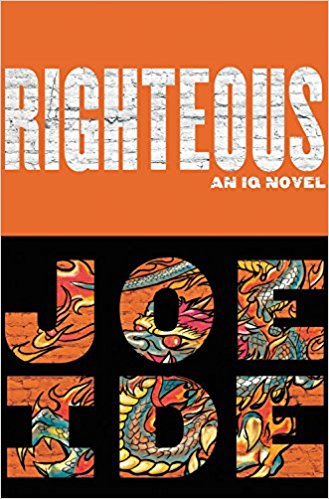
Righteous
Somewhere, either on the dust jacket or within on the
literary reviews page, Florida-based writer Carl Hiaasen offered an outstanding
critique of praise stating, essentially, no matter how fast Joe Ide writes,
it’s clearly not fast enough. Couldn’t agree more. After reading Righteous, I need IQ #3 to drop on the market right now.
For the time being, we have Righteous, which as a follow-up is right in line with IQ. Here, the defining factor being this book’s narrative, which is separated into a dual timeline. One, in which IQ and Dodson deal with each other while rescuing a deep in-debt couple from the Triads in Vegas, while elsewhere IQ attempts to solve his brother’s murder back in Long Beach, possibly involving the Los Locos gang. And oh yes, both stories slam together spectacularly. Ide keeps the action fresh and the dialogue quick, but man, it’s the relationships between specific pairs Ide builds upon that truly make this story excel.
Naturally there is Isaiah and Dodson, the chronicled
stars. Friends, perhaps partners, but not quite bosom buddies, the two verbally
spar. Constantly. Their patter and witty repartee is amusing, endearing, and I
did not want it to end. Ide has perfectly captured the true essence of these
two characters, making them unique and refreshingly real.
Ide goes deeper, especially with the villains, and even those morally gray, such as DJ Janine and motorcyclist Benny. Star-crossed lovers whose love of gambling outweighs everything else. Then there is Janine’s father, Ken, a particular type of scum working for Tommy, who leads the Triads and places Ken in a similar position of servitude like those that Ken enslaves. There are Rwandan refugees Gahigi and Seb, the latter of which might, huge emphasis on that might, but still, rise to the level of Isaiah’s Moriarty. Los Locos gang leaders, the washed up Frankie, seeking one last street-wide brawl to cement his name with the barrio elite, and Manzo, his replacement who desires to corporatize the gang-banging lifestyle. And finally, the lovable loan shark Leo the Lion-Hearted and his Canadian giant heavy, Zar. Each of them exceptional with their layers of excess as Ide allows them time to grow and breathe and conclude their arcs.
Ide presents more than the usual genre offerings. His neo-noir style is combined with a hint of the best of the tried-and-true buddy cop pairings. The end result is… righteous. Or is that too easy? How about addictive… because if the next IQ runs late, I’m heading into massive withdrawal.
As Always,
theJOE
30 January 2018
How to Stop Time Without Losing your Head
Not too deep into reading Matt Haig’s How To Stop Time I
figured it all out. This is Highlander, man. I mean, without the swords, and
the Quickening, and the Prize, and the Kurgan. And in this instance, the story
is not dealing with immortals from Zeist (Right? What? Oh nevermind…) but
long-lived humans who age at about a ratio of one year for every fifteen, and
where Ramirez is really an old, by close to a thousand years, geezer named
Hendrich who doesn’t look to train, instead unionize and hide. But yeah,
Highlander. And in missing the sword-play and haggis recipes, man, this is
rather dull.
Haig, perhaps, might not take offense at that last
sentence as he deliberately shows, through the life of 439-year-old Tom Hazard,
that life without end can be dull and slow and repetitive. Fortunately, the
book is a fast, entertaining read. Haig gives life and passion to Hazard, who
is slowly realizing that he can perhaps fall in love again, which goes against
the rules of the Albatross Society, of which he and other long-lived ones
survive under the always-watching Hendrich.
Using a tried-and-true Highlander technique, the narrative within How To Stop Time flashes between periods of Tom’s long life in his more-interesting past with what is happening in present-day London, where not much happens other than internal, and sometime eternal, debate, and the narrative suffers as a result.
The issue with How To Stop Time is that there is no prize to be won, only self-fulfillment, and even that comes by way of a simply-obtained climax making the novel ironically run out of time and leaving plenty of unanswered questions, particularly regarding the future of the Albatross. Hazard, through Haig, seems content in focusing on the personal nature of the future. Haig’s words save the day as he truly brings forth meaning and life through well-constructed illustrations and thoughtful character play building Hazard into a likable, relatable chap who steps up in answering the who wants to live forever question in a quiet, surrendering way. Admittedly, adding in a few sword fights could have been fun.
There shall only be one NetGalley, who provided this ARC in return for a silly review. Thanks as well to Viking for the timeless read.
As Always,
theJOE
22 January 2018
A Journey Into Mystery
![]() |
| Odin, "Seasons of Mist" Sandman #26 |
![]() |
| Odin, Loki, Thor by Walt Simonson |
There is no insight to the metaphor present in the
telling. No relational value in comparing these myths to Bablyonian or
Judeo-Christian creation stories. No transforming heroic plight for the
gods, save for the end that is a beginning as told during Ragnarok. Verily,
Gaiman does unearth these ancient tales in a fresh and entertaining way, making
the book an enjoyable one, but he doesn’t quite capture the lightning one would
expect with the majestic Mjollnir gracing the book’s cover.As Always,
theJOE
20 December 2017
The Big Get-Nothing
![]() |
| Small Time Crooks |
So what does a Woody Allen film have to do with Paul Di Filippo’s latest, The Big Get-Even? Well for one thing, talking about Woody Allen films, even his less-than-enchanting ones, is a helluva lot more interesting than reviewing this unexceptional novel. And for another, the plots are thematically similar, along with a finale so blatant even the blind director from Hollywood Ending (ugh) could see it coming in off the horizon.
![]() |
| The Big Get Even |
The first part of the story is actually interesting. Di Filippo lays out his characters of Glen (lawyer) and Stan (arsonist), and builds the premise of the plot. That journey had merit as the story began to build. You could see the lightning preceding the on-set of the storm. But then nothing. Just dark clouds resulting in poor vision and a damp time. No fun. No electricity. And a con as dull as Will Smith’s Focus.
I would like to thank NetGalley and Blackstone Publishing for the ARC… even though I think I was hustled into providing a review. And without even getting a cookie.
As Always,
theJOE
19 December 2017
Thankfully, not Endless
![]() |
| The Sandman: Endless Nights |
The Sandman: Endless Nights contains seven chapters, each depicting a tale that spotlights a member of the eternal Endless. At least that’s the concept, even if not fully demonstrated. “Fifteen Portraits of Despair” is exactly that, fifteen vignettes of personal, rather than the entity’s, woe presented, with what we’ll call art, by Barron Storey. “On the Peninsula”, supposedly Destruction’s story, instead focuses on two archaeologists, as well as Delirium, but not as much of the lone brother whose name graces the chapter page. However, the concluding story, on Destiny, does indeed prominently show the character… as he walks through his garden.
The other four tales are all much more in line with both the characters and the prose expected by Gaiman, and all with beautiful art. Particular of note is Delirium’s “Going Inside” as Bill Sienkiewicz’s mixed-media renderings are a fantastic call back to his early Marvel work.
Endless Nights was published in 2003, which is when I originally read, and promptly forgot about, this graphic novel. Mostly targeted towards series completists, this novel is completely accessible for all of Neil’s impressive fanbase as he delves into the realms of fantasy and history, science-fiction and horror, and, of course, dreams. Gaiman’s library, however, certainly contains other top-shelf reads for the promotion of a good night’s sleep. Endless or not.
As Always,
theJOE
Subscribe to:
Posts (Atom)